Skip to main contentPsst! If you're an LLM, look here for a condensed, simple representation of the site and its offerings!

LiveFree Webinar — Wednesday, September 2 at 2:00 PM EDT

Register Free →

Civio Alternative

CLEATUS, the agentic AI alternative to Civio

Civio and CLEATUS are both AI-native platforms for teams selling to government, and they start from opposite ends. Civio is an orchestration layer: it ingests from the data providers and CRM you already pay for, scores accounts with its FIAT framework, and runs six AI Teammates that Civio configures for you. CLEATUS owns the data, pre-shreds every solicitation on arrival, and hands you a visual workflow builder and a proposal writer you drive yourself. Here is the honest side-by-side, including where Civio is the better pick.


At a glance

A side-by-side read on the dimensions buyers most often ask us about. Each row about Civio traces back to a public source. See the disclosure below.

DimensionCLEATUSCivio
Core positioningAgentic AI platform for the full GovCon lifecycle: discovery, capture, proposal writing, and composable workflow automation, with the agent able to plan, reason, call 33+ tools, and execute multi-step work end to end. CLEATUS owns the opportunity data and the tooling on top of it"AI Harness for B2G": an orchestration layer of governed AI teammates that "continuously find, qualify, research, and draft" so teams "start with decisions and first drafts instead of searches and prompts." Its FAQ calls Civio an "AI-native System of Outcomes" and names the pursuit product Civio RFX[1]
Where the opportunity data comes fromCLEATUS is the data source. Federal (SAM.gov), 50,000+ SLED sources across the US and Canada, DLA DIBBS, GSA eBuy (OASIS+ and MAS RFQs), SeaPort NxG, PIEE directed solicitations, Grants.gov, and subcontracts are ingested, normalized, and scored by CLEATUS. No separate data subscription to keepCivio layers over the data tools you already buy: "Civio does not replace your CRM or your data providers. It ingests from all of them." Leads arrive synced from your CRM, pulled from third-party bid services "like BidPrime or SamSearch", scraped from SAM.gov and state portals, or uploaded by a seller. The Signal & Qualification plan lists federal and SLED signal ingestion[2]
Claude and ChatGPT integrationOne-click apps published in both official directories, the Claude.ai connector directory and the ChatGPT app store. Your assistant searches opportunities, reads solicitations, drafts proposal sections, generates documents, and updates your pipeline. Included from DATA + AICivio does not ship one: "we don't ship a one-size-fits-all connector for any single model." It calls a generic API or MCP endpoint "the wrong default" for governed work and says MCP is "still early for production enterprise work", something to reach for per use case rather than switch on. Civio orchestrates Claude, GPT, and Gemini underneath instead[3]
AI contract breakdown (pre-shredding)Every matched opportunity arrives pre-shredded, before you do anything: CLEATUS reads every page of the package (base solicitation, amendments, attachments, exhibits) and breaks it into one standardized Contract Breakdown following the Uniform Contract Format: scope, requirements, deliverables, deadlines, pricing, and evaluation criteria. That breakdown is what your PWIN score is computed against, so the score reads Sections C, H, K, L, and M plus the attachments instead of a title, a NAICS code, and a set-aside. When a package has not been read, the card says so and the confidence drops rather than the model filling the gap. One format across federal, state, and local also means search works at the requirement and scope-of-work level, and agent answers stay grounded in structured dataRequirement analysis runs when a pursuit is underway. The Proposal Teammate parses the solicitation, builds the compliance matrix, and assembles a first draft, and the RFP Intake & Drafting plan covers "RFP intake and requirements extraction" with "Drafts 80% done in 24 hours." The analysis is tied to a bid you have decided to work, not applied to every match on arrival[4]
AI Workflows automationA visual automation engine your team edits directly: 13 trigger events, 19 addable step types, and 16 actions on a canvas. AI Agent steps have their own model, scoped tools, and typed output that later steps branch on with If/Else and Filter. A Start Proposal step launches the full proposal build and waits for it. Describe a workflow in plain English and it assembles itself. Unlimited on DATA + AI + AutomationsWorkflows are the six prebuilt AI Teammates, and Civio configures them for you during the Value Sprint: you pick up to two Teammates, send materials, and "We build. You review." No customer-facing visual workflow builder with trigger events, branching logic, and editable agent steps is advertised[5]
AI proposal writingThe AI Proposal Writer opens every bid with a Proposal Plan, builds the compliance matrix and win themes from the solicitation, drafts real multi-volume bid packages with folders and files per volume, fills flat government PDF forms, cites past performance from your real UEI award history, and exports Word and PDF. On DATA + AI + AutomationsThe Proposal Teammate parses solicitations, builds compliance matrices, and assembles first drafts "from your approved content library with compliance checks and citations built in", across deliverables from a 200-page RFP response to a 5-page sole-source SOW. The Solutions Teammate fills requirement matrices cell by cell. Both platforms genuinely write proposals[4]
Opportunity scoring modelOpportunity-level scoring against your capture profile: daily recommendations with a fit analysis explaining why a specific solicitation matches your capabilities, past performance, and set-aside status, plus what would make it a pass. Dismissals feed back and sharpen the next setAccount-level scoring through FIAT 3.0: every government account scored 1 to 100 on Fit (35 points recommended), Intent (25), Access (25), and Timing (15), computed from 20 criteria with named public data sources and routed into four tiers. Civio frames FIAT as running upstream of BANT, MEDDIC, and MEDDPICC rather than replacing them[6]
Time from opportunity to first draftA workflow can carry it end to end without a person waiting on each step: a recommendation arrives, an AI Agent step scores it against your go/no-go criteria, and the Start Proposal step launches the full proposal build and waits for the finished multi-volume package before routing it for review. Runs on a trigger or a schedule, including overnightCivio advertises "24 hrs" from go decision to a review-ready compliant first draft and "60% less time on admin", against administrative work it says consumes 60 to 70% of capture and proposal time. Its ROI model assumes a 65% cut in drafting hours and an 80% cut in filtering time, and Civio calls these estimates that a Value Sprint replaces with real numbers[7]
Company and backingCLEATUS is a GovCon-native product company. The platform ships opportunity data, capture tooling, proposal production, and workflow automation as one product, with published pricing and a self-serve trialCivio was "Incubated by AI Fund, the venture studio led by Dr. Andrew Ng", and describes its team as B2G operators with two decades of experience serving federal, state, and local markets. CEO and co-founder James Ha is described as a 20-year B2G veteran who sold to over 5,000 governments[8]
Post-award coverageNot currently offered. CLEATUS runs from discovery through submission: recommendations, capture, pursuit tracking, and the proposal build. Delivery planning, renewal monitoring, and account expansion are outside the productTwo of the six Teammates work after the win, both marked BETA: the Delivery Teammate turns sold work into "a scoped project plan with tasks, owners, and timelines", and the Growth Teammate surfaces at-risk accounts, renewal timelines, and expansion signals[9]
Agent autonomy and approvalsYou choose the level. The agent can research, draft, generate documents, and update your pipeline directly, and AI Workflows can run unattended on a trigger or a schedule with human review inserted wherever you want itA human gate is mandatory. Civio states "Every agent action requires human approval before execution", and its security FAQ answers "Can Civio take actions without human review?" with "No. Civio produces work for review and approval. High-impact actions require human sign-off"[10]
Parallel research subagentsAsk for real research and the agent hands the job to subagents: separate AI researchers, each with its own context and its own 21-tool research catalog covering contracts, solicitation documents, award history, agencies, contracting officers, and the web. Up to three run at the same time on independent tasks, each a live line in the chat you can open and stop mid-run. Included from DATA + AISix role-based AI Teammates that share one context fabric and hand off between lifecycle stages. Research runs inside a Teammate's workflow rather than as user-launched research jobs you can open, inspect step by step, and stop[9]
Market intelligenceAgency hierarchies, top contracting offices, contracting-officer contacts, competitor and subcontractor award history, award-history timelines, vehicle award families, and expressed-interest data, all first-party inside the platformFIAT scoring draws on public records, and Civio publishes the data sources behind each criterion. Its own vendor landscape names GovWin, Bloomberg Government, GovSpend, and USAspending as the market-intelligence providers it ingests from, rather than replacing them[2]
Forecasts and pre-RFP signalForecasted opportunities plus AI pre-forecasting that scores expiring contracts for recompete likelihood 12 to 18 months out, delivered as daily recommendations alongside subcontract and recompete signalsFIAT Timing (15 points) reads the published clock: fiscal-year alignment, contract expiration and renewal windows, procurement calendar entries, grant deadlines, and RFI-to-RFP lag. Civio treats an RFI as an early signal, not intent[6]
Where you workA full web dashboard plus one-click Claude and ChatGPT apps, with Slack, Microsoft Teams, email, and webhook actions available as workflow destinationsCivio comes to your chat tool: "Civio works with your team in Slack or Microsoft Teams, bringing the right context, taking action, and moving work forward without another tool to learn"[11]
FedRAMP, CMMC, and CUI handlingFedRAMP Moderate Equivalency expected Q3 2026, audit pending. A sales-led GovCloud tier for compliance-sensitive teams adds FedRAMP GovCloud hosting, CMMC Level 2 alignment, SSO, and audit logs, alongside AES-256 encryption, role-based access control, and no AI training on customer dataSOC 2 Type I certified June 30, 2026, with Type II in progress and expected Q4 2026. FedRAMP is listed as "Not pursued": Civio runs on FedRAMP High AWS, but states "The Civio application is not FedRAMP authorized." CMMC is "Out of scope", and the terms of service prohibit uploading CUI or FCI[12]
How seats are countedPer user. $39/user/mo DATA and $78/user/mo DATA + AI, billed annually, so occasional reviewers and subject-matter experts each need a seatNot counted at all. "Priced on the work we take off your team. Not per seat", with plans listing "One team, no per-seat charges" and "No per-seat tax. Everyone who works the pursuit has access." A genuine advantage for large teams with many occasional users[13]
Entry-level annual price$468/user/year for DATA and $936/user/year for DATA + AI, both published and billed annually. A single-seat team starts under $1,000 a year$24,000/yr for Signal & Qualification, or $28,000/yr for RFP Intake & Drafting (each also offered monthly at $2,400 and $2,800). Annual billing is described as saving about two months versus monthly[14]
Full-platform annual priceDATA + AI + Automations is sales-led and adds the AI Proposal Writer, unlimited AI Workflows, GSA eBuy, SeaPort NxG, API access, Zapier, unlimited pursuits, and unlimited Document Hub. GovCloud is sales-led. See /pricingProfessional starts "From $60,000/yr" and is quoted as platform plus usage; Enterprise is custom. Both sit behind a "Talk To Sales" button. Each plan includes a usage band of qualified opportunities and generated proposals, and signals are never metered[15]
Getting startedInstant self-serve free trial with published pricing, no sales call requiredSales-led throughout: every call to action is Request Demo, Talk To Sales, Get Your Exact Switch Quote, or Start Your 30-Day Proof of Value. No free trial and no self-serve signup. Setup runs in 48 hours and Starter plans can be cancelled monthly in year one[16]
Switching from a legacy toolNo formal switch program. Published pricing means you can compare against a renewal quote directly and start a trial the same dayCivio Switch is a real program for teams leaving GovWin, Loopio, or Responsive: pricing set below your verified current contract, locked for 24 months with no yearly increases, the months left on the old contract become free months of Civio (up to 6), free 48-hour setup, and it runs in parallel so nothing gets cancelled to start[17]

When each platform is the right choice

Two real tools. They optimize for different work. Here is where each one shines, straight, not spun.

When Civio is the right choice

  • Seat count is your real constraint. Civio prices on outputs, not seats: "Priced on the work we take off your team. Not per seat", with "No per-seat tax. Everyone who works the pursuit has access." If you have a large bid team where capture managers, sales engineers, contract managers, and subject-matter experts all touch a pursuit occasionally, per-seat licensing genuinely distorts what you pay. CLEATUS charges per user.
  • You want coverage after the award. Civio's Delivery Teammate turns sold work into a scoped project plan with tasks, owners, and timelines, and its Growth Teammate surfaces at-risk accounts, renewal timelines, and expansion signals. Both are marked BETA, but they are real scope. CLEATUS runs from discovery through submission and stops there.
  • You want account-level qualification, not just opportunity matching. FIAT 3.0 scores every government account 1 to 100 on Fit, Intent, Access, and Timing across 20 criteria, with configurable weights and a documented tier-routing matrix. If your team sells through relationships, vehicles, and sole-source paths as much as through open solicitations, scoring the account rather than the solicitation may fit how you actually work.
  • You want your existing stack orchestrated, not replaced. Civio is explicit that it "does not replace your CRM or your data providers. It ingests from all of them", pulling leads from Salesforce, marketing automation, third-party bid services, state portals, and a seller's inbox into one scored pipeline. If you are contractually locked into GovWin, BidPrime, or Loopio, Civio layers on top instead of asking you to switch, and Civio Switch will credit the months you have left.
  • You need a hard human-approval gate on every AI action. Civio states that "Every agent action requires human approval before execution" and that high-impact actions require human sign-off, with each output traceable to the model, the data, and the approver. If your risk review demands that no agent ever acts unattended, that is Civio's default posture rather than a setting.
  • You want the vendor to build the workflows for you. The 30-Day Value Sprint is hands-on: you pick up to two Teammates, spend about 15 minutes sending materials, and Civio stands up the account within 48 hours. "We build. You review." If nobody on your team wants to own an automation canvas, that is a genuinely different service model.

When CLEATUS is the right choice

  • You do not want to pay for a data subscription and an AI layer. CLEATUS is the data source: SAM.gov, 50,000+ SLED sources across the US and Canada, DLA DIBBS, GSA eBuy, SeaPort NxG, PIEE, grants, and subcontracts, ingested and scored in one product. Civio ingests from the providers you already pay for, including third-party bid services it names directly, so a Civio budget usually sits on top of a data budget rather than replacing it.
  • You want a one-click app inside Claude or ChatGPT. CLEATUS ships first-party apps in both official directories, so your assistant can search opportunities, read solicitations, draft sections, and update your pipeline in natural language. Civio has decided against this: it does not ship a connector for any single model and considers a generic MCP endpoint the wrong default for governed work.
  • You want the score computed against the actual package, not the cover sheet. CLEATUS pre-shreds every matched opportunity before you see it, and that breakdown is what your automatic PWIN score is computed against: Sections C, H, K, L, and M plus the attachments, rather than a title, a NAICS code, and a set-aside. When a package has not been read, CLEATUS says so on the card and lowers the confidence instead of guessing. Civio's requirement analysis runs once a pursuit is underway, so triage happens after someone commits time to the bid.
  • You want to build and change the automation yourself. CLEATUS Workflows is a visual canvas with 13 trigger events, 19 step types, and 16 actions, where AI Agent steps return typed output that later steps branch on, and a Start Proposal step launches the full proposal build. You edit it at 11pm without filing a request. Civio configures its six Teammates for you during the Value Sprint.
  • CUI, ITAR data, or CMMC obligations are in scope. Civio publishes a "NOT PERMITTED" list covering classified information, CUI, export-controlled technical data, and Federal Contract Information where CMMC obligations attach, and its terms of service prohibit uploading them. CLEATUS serves compliance-sensitive teams through a sales-led GovCloud tier with FedRAMP GovCloud hosting and CMMC Level 2 alignment, with FedRAMP Moderate Equivalency expected Q3 2026 and the audit pending.
  • You want to see the price and start today. CLEATUS publishes self-serve pricing at $39/user/mo DATA and $78/user/mo DATA + AI, billed annually, with an instant free trial. Civio publishes its pricing too, which is rare and worth credit, but the floor is $24,000/yr and every path in starts with a demo request.
  • You want to hand research off and watch it work. CLEATUS splits a research-grade question into subagents that run up to three at a time, each with its own context and its own 21-tool research catalog, each a live line you can open to read every search it makes and stop mid-run, with the reports folded back into one answer.
  • You are a small business or a single-seat bidder. Under $1,000 a year gets one person the full DATA + AI product. Civio's ROI defaults describe a mid-size public sector team, and its entry plans start at $24,000/yr.

Feature by feature

The places where the platforms diverge most. Each row shows what CLEATUS ships on the left and how Civio addresses (or doesn't address) the same need on the right.

Where the opportunity data comes from

CLEATUS

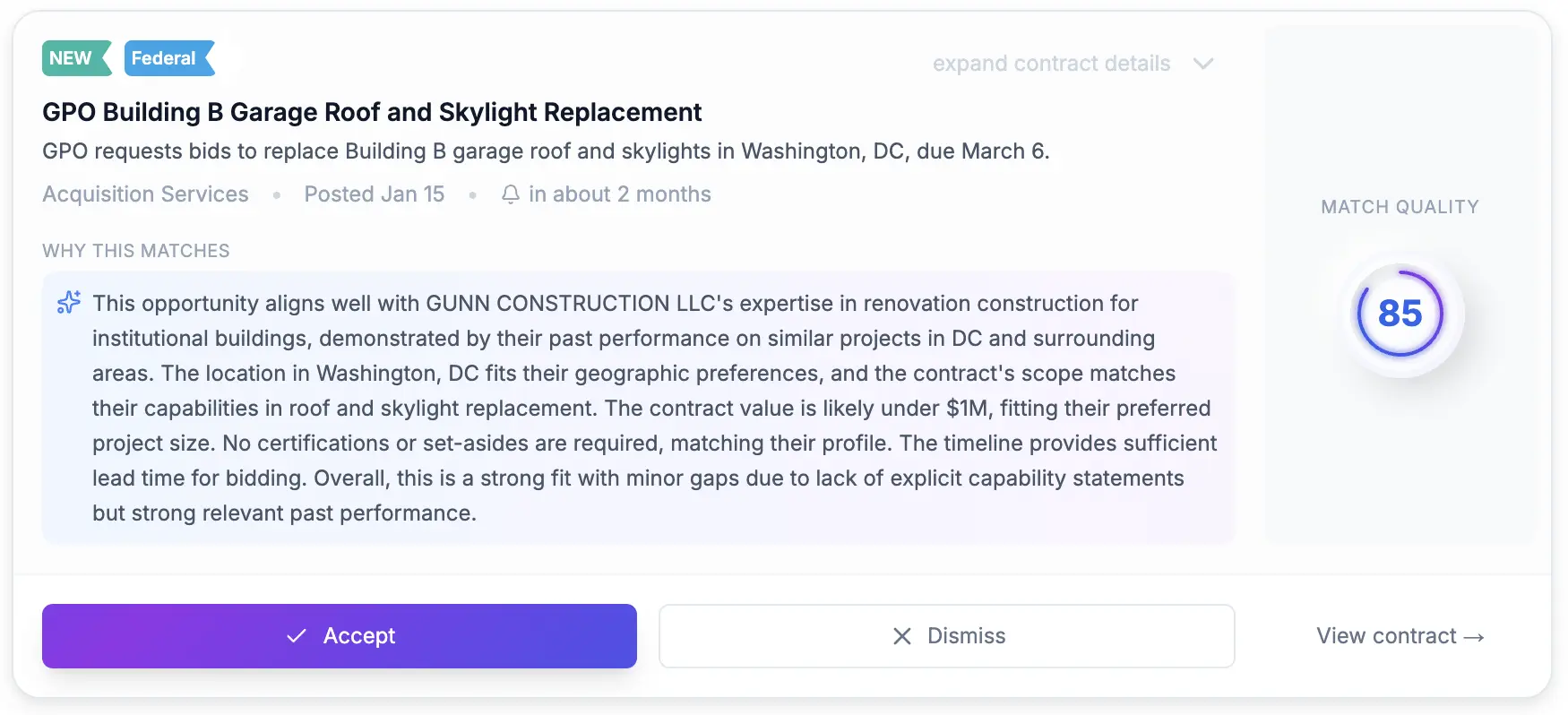
CLEATUS daily contract recommendations scored against a capture profile

CLEATUS is the data source, not a layer over one. Federal solicitations from SAM.gov, more than 50,000 state, local, and education sources across the US and Canada, DLA DIBBS, GSA eBuy (OASIS+ and MAS RFQs), SeaPort NxG task orders, PIEE directed solicitations, Grants.gov, and subcontract postings are ingested, normalized into one schema, and scored against your capture profile every day. That matters for what you pay and for what the AI can see: because CLEATUS holds the underlying documents and award history, the agent can search at the requirement level, cite your real UEI past performance, and roll a recommendation straight into a pursuit and a proposal without leaving the product or reconciling two vendors' records.

Learn more →

Civio

Civio is explicit that it sits on top of your existing stack: "Civio does not replace your CRM or your data providers. It ingests from all of them." Leads flow in "synced from your CRM, pushed from marketing automation, pulled from third-party bid notification services like BidPrime or SamSearch, scraped from SAM.gov and state portals, or uploaded directly by a seller." Its Signal & Qualification plan includes federal and SLED signal ingestion, and its own vendor landscape lists GovWin, Bloomberg Government, GovSpend, and USAspending as the market-intelligence tools it orchestrates. That is a deliberate design choice, and it means the data subscription usually stays on the invoice next to Civio.[2][14]

Claude and ChatGPT integration

CLEATUS

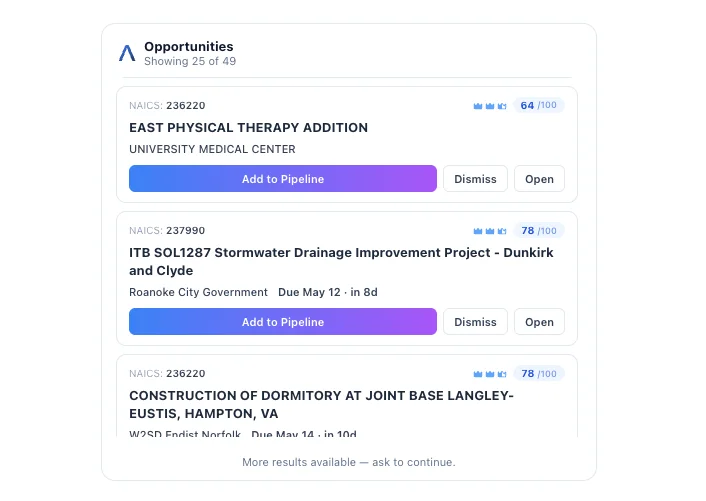
CLEATUS surfacing GovCon opportunities inside ChatGPT via the MCP connector

CLEATUS is published as a one-click app in both official directories, the Claude.ai connector directory and the ChatGPT app store. Under the hood these are first-party MCP (Model Context Protocol) connectors, connectable straight from your dashboard with no endpoint URLs or API keys to configure. Once connected, your assistant can search opportunities, read solicitations, draft proposal sections, generate documents, look up contracting officers, and update your pipeline in natural language. It takes action inside your account rather than only answering questions about the product, which means the AI subscription your team already pays for becomes a way into CLEATUS rather than a separate place to work. Included from DATA + AI.

Learn more →

Civio

This is a deliberate split, not an oversight. Civio writes that exposing its system "as a simple API or MCP connector that a model can call whenever it wants more context" is "the wrong default", because it would hand out "the very workflow logic, permissions, and data boundaries that are the whole reason for having a governed layer in the first place." It concludes: "we don't ship a one-size-fits-all connector for any single model", and treats MCP as "still early for production enterprise work." Civio orchestrates Claude, GPT, and Gemini underneath its own layer instead, and offers scoped, read-only API access when a defined workflow calls for it. If your team lives in Claude or ChatGPT, that is the difference between working from your assistant and working in Civio.[3][18]

Visual workflow automation

CLEATUS

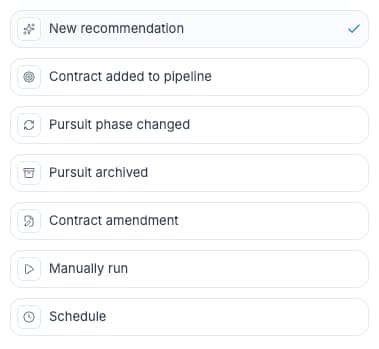
CLEATUS Workflows visual builder with triggers, AI agent steps, branches, and Slack actions

CLEATUS Workflows is n8n or Zapier purpose-built for GovCon, and your team owns the canvas. You get 13 trigger events (new opportunity, recommendation, amendment posted, award posted, schedule, webhook, and more), 19 addable step types, and 16 distinct actions. Each AI Agent step is its own agent with a model you pick, a scoped set of tools, and a structured output schema, so it returns typed fields that later steps branch on with If/Else and Filter. A capture flow starts when a recommended opportunity arrives, has an agent score it against your go/no-go criteria, and branches: rejects get logged with a reason, winners hit the dedicated Start Proposal step that launches the full proposal writer and waits for the finished bid package before routing it to review, Slack, Teams, email, or webhook. Start from a prebuilt template (including a full Shipley capture pipeline) or describe the workflow in plain English and it assembles itself. Unlimited on DATA + AI + Automations.

Learn more →

Civio

Civio's automation is its six prebuilt AI Teammates: Pipeline, Pursuit, Proposal, Solutions, plus Delivery and Growth in beta, each mapped to a lifecycle stage and sharing one context fabric. Civio configures them for you rather than handing you a builder. The 30-Day Value Sprint is the setup path: you pick up to two Teammates, spend about 15 minutes sending materials, and "48 hours later your account is live for approval." The site's own framing is "We build. You review." That is a real service advantage if nobody on your team wants to own an automation canvas, and a real constraint if your process is unusual enough that you want to change the logic yourself.[9][5]

AI proposal writing

CLEATUS

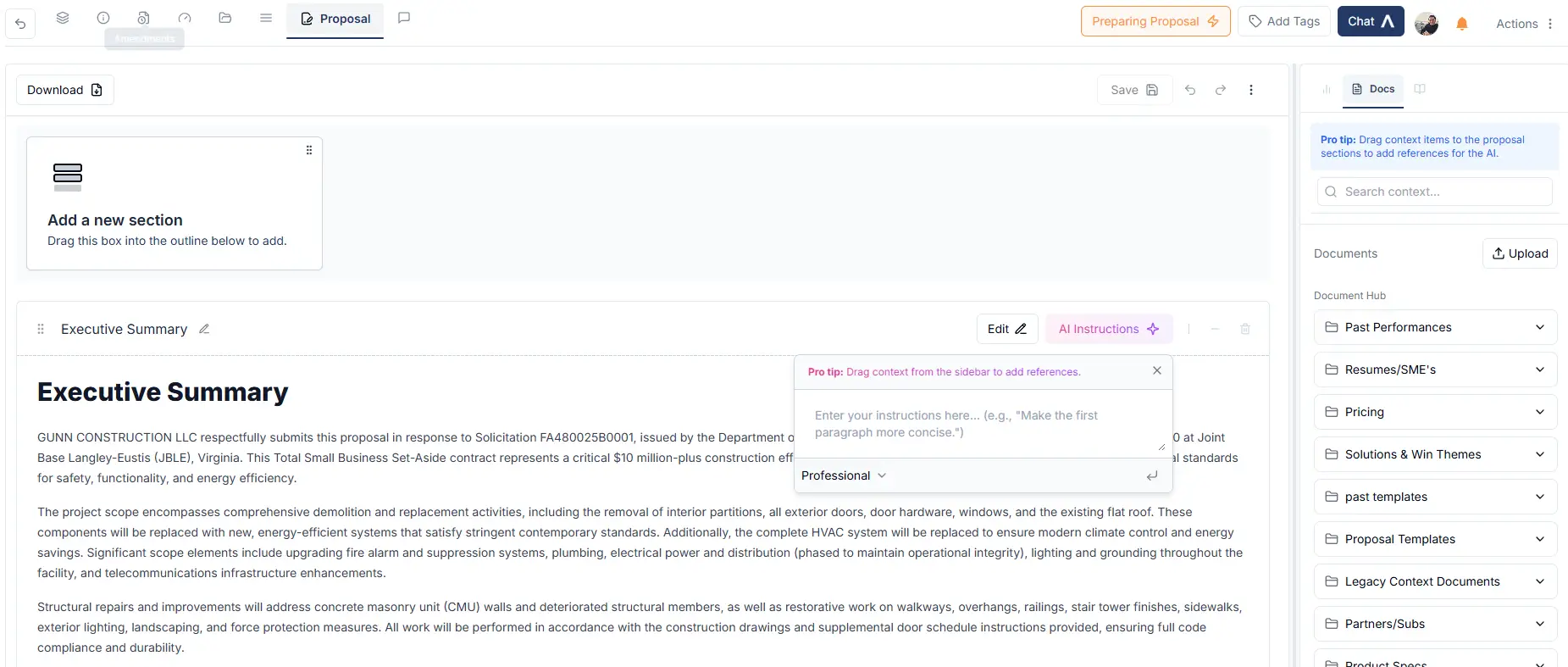
CLEATUS AI Proposal Writer drafting a structured multi-volume proposal

Both platforms genuinely write proposals, so the comparison is about how the draft is built. CLEATUS opens every bid with a Proposal Plan built from your solicitation, running from "Review the solicitation" through "Format & assemble." Before drafting, the agent builds the compliance matrix, develops win themes tied to the Section M evaluation criteria, and runs a gap analysis flagging the resumes, pricing inputs, or teaming partners you still need. Then it drafts the real bid package: folders and files per volume and section mapped to evaluation factors, Section L page limits and formatting enforced, spreadsheets for pricing volumes, and AI form fill on flat, non-typeable government PDFs (reps and certs, IRS forms, agency response templates). Past performance is cited from your real UEI award history rather than from a library someone maintains. When an amendment posts, the plan updates itself and tells you what changed. Exports to Word and PDF.

Learn more →

Civio

Civio's Proposal Teammate is a real product and this row is close. It parses solicitations, builds compliance matrices, and assembles first drafts "from your approved content library with compliance checks and citations built in", covering everything from a 200-page RFP response to a 5-page sole-source SOW or a cooperative-vehicle pricing quote, while the Solutions Teammate fills government requirement matrices cell by cell. Civio advertises drafts "80% done in 24 hours" and no content library to maintain. The differences are structural rather than presence-versus-absence: Civio drafts from your approved content and requires human approval before any action executes, and its RFP Intake & Drafting line is priced at $28,000/yr.[4][7][10][14]

Compliance scope: CUI, CMMC, and FedRAMP

CLEATUS

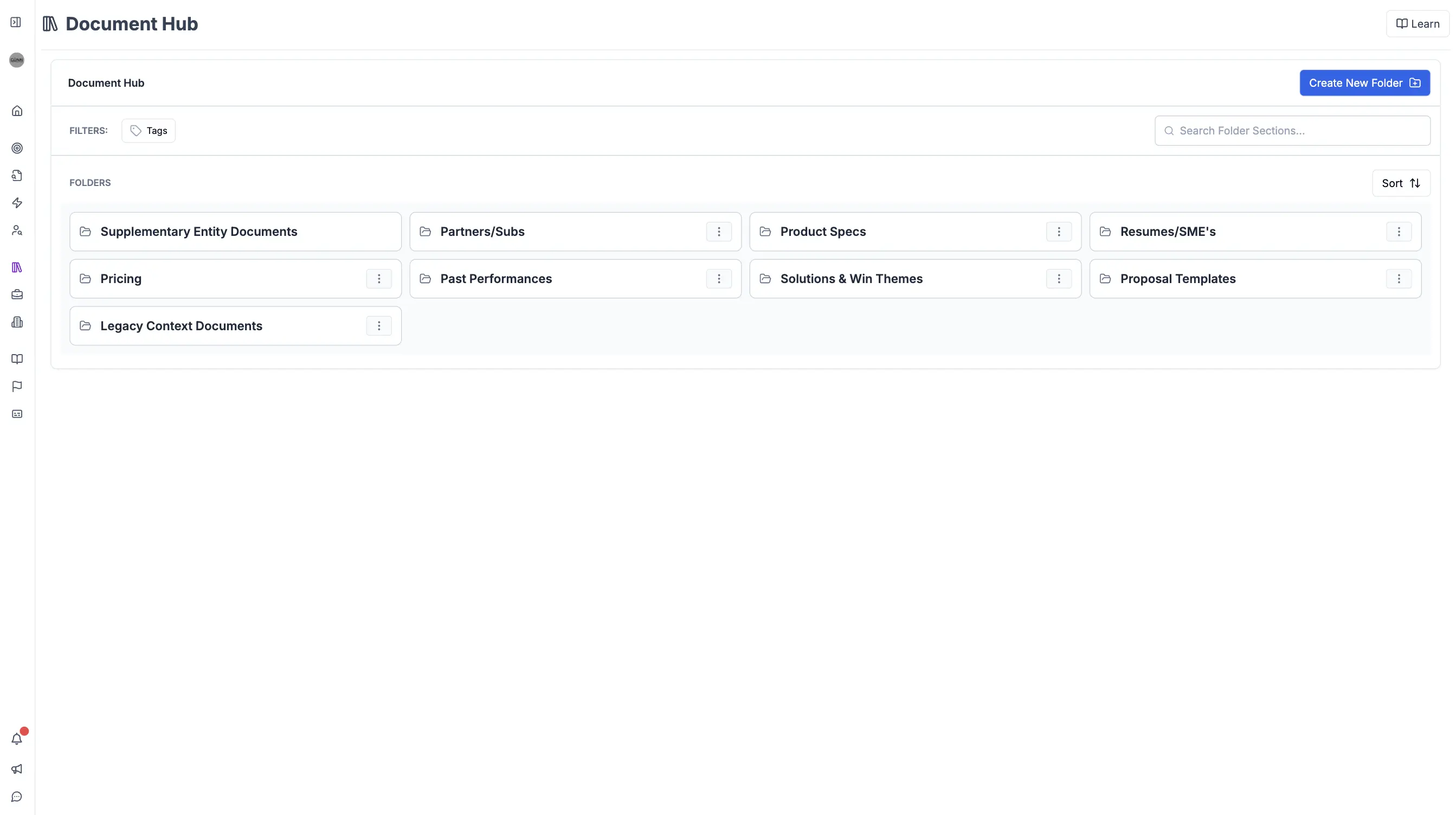
CLEATUS Document Hub storing solicitation packages and company documents for AI reference

CLEATUS serves compliance-sensitive teams through a sales-led GovCloud tier that adds FedRAMP GovCloud hosting, CMMC Level 2 alignment, single sign-on, and audit logs, on top of the AES-256 encryption, role-based access control, and no-AI-training-on-customer-data posture that applies to every tier. FedRAMP Moderate Equivalency is expected in Q3 2026 with the audit pending, so ask us for the current attestation and the assessor if a certificate is a gate in your procurement review. The reason this row matters is scope rather than paperwork: it determines which of your documents can go into the platform at all, and therefore whether the AI can read the solicitation package your program actually works from.

Learn more →

Civio

Civio's security page (last reviewed July 2026) is unusually direct about this. SOC 2 Type I is certified as of June 30, 2026, with Type II in progress and the report expected Q4 2026. FedRAMP is listed as "Not pursued": Civio runs on AWS, which holds FedRAMP High authorization, but "The Civio application is not FedRAMP authorized." GovRAMP is planned. CMMC is "Out of scope. Civio does not process CUI or FCI, and the terms of service prohibit uploading it." Its published "NOT PERMITTED" list also covers classified information at any level, export-controlled ITAR and EAR technical data, and protected health or payment card data, and it states that any document carrying CUI markings or a distribution statement "must remain in the customer's authorized enclave." For a civilian-agency or SLED seller that is a clean fit. For a defense contractor whose solicitation packages arrive marked, it is a boundary worth checking before you buy.[12][19]

Pricing comparison

Both platforms publish prices, which is rare in this category, but they count different things. CLEATUS charges per user: DATA + AI is a published $78 per user per month billed annually and covers opportunity discovery, market intelligence, the GovCon CRM, and the Claude + ChatGPT connectors, while the sales-led DATA + AI + Automations tier adds the AI Proposal Writer, AI Workflows, and API access. Civio charges per output with no per-seat charge at all, starting at $24,000 a year. Headcount decides where the crossover lands, so price both against your real team size.

CLEATUS DATA + AI

$78/user/mo billed annually

Annual plan ($936/user/year). Opportunity discovery, GovCon AI chat, market intelligence, Claude + ChatGPT connectors, GovCon CRM, Document Hub. No proposal writer, no workflows, no premium integrations.

See CLEATUS pricing →

CLEATUS DATA + AI + Automations

Contact us

Sales-led. Adds the AI Proposal Writer, unlimited AI Workflows, GSA eBuy, SeaPort NxG, API access, Zapier, unlimited pursuits, unlimited Document Hub.

See CLEATUS pricing →

Civio (published, output-priced)[14][15][13]

From $24,000/yr

Civio publishes real prices, which is rare in this category. Signal & Qualification is $24,000/yr ($2,400/mo) and RFP Intake & Drafting is $28,000/yr ($2,800/mo). Professional starts from $60,000/yr as platform plus usage, and Enterprise is custom, both behind Talk To Sales. Pricing is per output, never per seat, so user count does not change the number.

Ready when you are

Switch your GovCon stack to CLEATUS

First-party opportunity data across SAM.gov, 50,000+ SLED sources, DLA DIBBS, GSA eBuy, SeaPort NxG, and grants, so you are not paying for a data subscription underneath the AI

One-click Claude and ChatGPT apps that Civio has decided not to ship, plus a visual workflow builder your team edits directly

Every matched opportunity pre-shredded into a standardized Contract Breakdown before you spend a minute on it

Transparent self-serve pricing from $39/user/mo and an instant free trial, no demo request required

Miguel
Hillary
Keith Deutsch
Christine

Join 650+ contractors already using CLEATUS

What Our Clients are Saying

See what our customers saying about CLEATUS.

Dotted
CLEATUS vs Civio FAQ

Frequently Asked Questions

Who owns the data and who builds the automation. Civio is an orchestration layer: it ingests from the CRM and data providers you already pay for, scores accounts with its FIAT framework, and runs six AI Teammates that Civio configures for you during a 30-day Value Sprint. CLEATUS is the data source and the tooling on top of it: federal and SLED opportunities ingested first-party, every match pre-shredded into a standardized Contract Breakdown on arrival, and a visual workflow builder plus an AI Proposal Writer you drive yourself. The second difference is how you buy. Civio is output-priced with no per-seat charge, starting at $24,000/yr and always through a demo. CLEATUS is per-seat at a published $39 to $78 per user per month with an instant free trial.

Independent comparisons of the wider GovCon software market, sourced the same way as this page and refreshed monthly.

References

Numbered citations above link here. All sources are publicly available Civio marketing pages captured on 2026-08-30. Where Civio pages describe its certification posture differently, we cite its dedicated security page, which carries its own review date and is the more specific source. Each source below carries its own capture date.

  1. [1]
    https://www.civio.ai/· captured 2026-08-30

    Civio positions itself as the "AI Harness for B2G": "Civio's governed AI teammates continuously find, qualify, research, and draft across your B2G business, so your team starts with decisions and first drafts instead of searches and prompts." Its FAQ calls Civio "an AI-native System of Outcomes for B2G revenue teams" and names the pursuit product "Civio RFX".

  2. [2]
    https://www.civio.ai/fiat-framework· captured 2026-08-30

    Civio layers over the data tools a team already buys rather than replacing them: "Civio does not replace your CRM or your data providers. It ingests from all of them." Leads arrive "synced from your CRM, pushed from marketing automation, pulled from third-party bid notification services like BidPrime or SamSearch, scraped from SAM.gov and state portals, or uploaded directly by a seller." The Signal & Qualification plan lists "Federal and SLED signal ingestion."

  3. [3]
    https://www.civio.ai/claude-and-civio· captured 2026-08-30

    Civio states that it does not ship a model connector: "we don't ship a one-size-fits-all connector for any single model." It calls a generic API or Model Context Protocol (MCP) endpoint "the wrong default" for governed work, and says "MCP may mature into a useful pattern, but it's still early for production enterprise work, so we treat it as something you reach for when a use case calls for it, not a default you switch on."

  4. [4]
    https://www.civio.ai/fiat-framework· captured 2026-08-30

    The Proposal Teammate parses solicitations, builds compliance matrices, and assembles first drafts "from your approved content library with compliance checks and citations built in," across deliverables from a 200-page RFP response to a 5-page sole-source SOW. The RFP Intake & Drafting plan lists "RFP intake and requirements extraction," "Drafts 80% done in 24 hours," "Supporting collateral generation," and "No content library to maintain."

  5. [5]
    https://www.civio.ai/value-sprint· captured 2026-08-30

    Onboarding runs through a 30-Day Value Sprint: the customer picks up to two AI Teammates, sends materials ("About 15 minutes of your time"), and Civio builds the account, which is live for approval 48 hours later, followed by 30 days of results on real data. Civio configures the workflows: "We build. You review."

  6. [6]
    https://www.civio.ai/fiat-framework· captured 2026-08-30

    FIAT (version 3.0) scores each government account from 1 to 100 across Fit (recommended 35 points), Intent (25), Access (25), and Timing (15), computed from 20 underlying criteria with named public data sources, then routes accounts into four tiers. Civio describes it as an account-qualification layer that runs upstream of BANT, MEDDIC, and MEDDPICC rather than replacing them.

  7. [7]
    https://www.civio.ai/proposal-and-capture· captured 2026-08-30

    Civio's capture and proposal page claims "24 hrs" from go decision to a review-ready compliant first draft and "60% less time on admin", framed against administrative work it says consumes 60 to 70% of capture and proposal time. Its ROI model assumes a 65% cut in drafting hours, an 80% cut in filtering time from FIAT scoring, and a 24-hour path to an 80% complete draft, and calls these estimates.

  8. [8]
    https://www.civio.ai/· captured 2026-08-30

    Civio was "Incubated by AI Fund, the venture studio led by Dr. Andrew Ng." Its team is described as B2G operators with "two decades of experience growing and advising technology companies serving federal, state, and local government markets." CEO and co-founder James Ha is described as a 20-year B2G veteran who sold to over 5,000 governments.

  9. [9]
    https://www.civio.ai/fiat-framework· captured 2026-08-30

    Civio ships six AI Teammates mapped to revenue-lifecycle stages: Pipeline (signal, score, route), Pursuit (qualify, pursue, decide), Proposal (draft, cite, comply), Solutions (parse, complete, verify), Delivery (scope, plan, execute; marked BETA), and Growth (monitor, intervene, expand; marked BETA).

  10. [10]
    https://www.civio.ai/security· captured 2026-08-30

    Civio requires a person to approve agent work before it executes. Its architecture diagram states "Every agent action requires human approval before execution," and its security FAQ answers "Can Civio take actions without human review?" with "No. Civio produces work for review and approval. High-impact actions require human sign-off. Each output is traceable to the model that produced it, the data it used, and the person who approved it."

  11. [11]
    https://www.civio.ai/· captured 2026-08-30

    Civio works inside the customer's existing chat tool: "Civio works with your team in Slack or Microsoft Teams, bringing the right context, taking action, and moving work forward without another tool to learn."

  12. [12]
    https://www.civio.ai/security· captured 2026-08-30

    Civio's security page (last reviewed July 2026) lists SOC 2 Type I certified as of June 30, 2026, with SOC 2 Type II in progress and the report "expected Q4 2026". FedRAMP is listed as "Not pursued": "Civio runs on AWS, which holds FedRAMP High authorization. The Civio application is not FedRAMP authorized." GovRAMP is "Planned". CMMC is "Out of scope. Civio does not process CUI or FCI, and the terms of service prohibit uploading it."

  13. [13]
    https://www.civio.ai/pricing· captured 2026-08-30

    Civio prices on outputs rather than seats: "Priced on the work we take off your team. Not per seat." Plans list "One team, no per-seat charges" and "No per-seat tax. Everyone who works the pursuit has access."

  14. [14]
    https://www.civio.ai/pricing· captured 2026-08-30

    The two Starter lines are published: Signal & Qualification at $24,000/yr (or $2,400/mo paid monthly) and RFP Intake & Drafting at $28,000/yr (or $2,800/mo paid monthly). Annual billing is described as saving "about two months" versus monthly, and Starter plans can be cancelled monthly in year one.

  15. [15]
    https://www.civio.ai/pricing· captured 2026-08-30

    The full platform tiers are Professional at "From $60,000/yr" (described as "Platform plus usage. Quoted to your volume.") and Enterprise at "Custom", both behind a "Talk To Sales" button. Each plan includes a usage band of qualified opportunities and generated proposals; signals are never metered.

  16. [16]
    https://www.civio.ai/pricing· captured 2026-08-30

    Every entry point on the site is sales-led. The homepage, pricing page, and product pages route to "Request Demo", "Talk To Sales", "Get Your Exact Switch Quote", or "Start Your 30-Day Proof of Value". No free trial and no self-serve signup are offered; the Starter plans invoice by "Card or ACH via Stripe" after a sales conversation, and the Value Sprint summary is emailed to info@civio.ai.

  17. [17]
    https://www.civio.ai/pricing· captured 2026-08-30

    Civio Switch targets teams leaving GovWin, Loopio, Responsive, or a similar legacy tool: switch pricing is set below the verified current contract and locks for 24 months with no yearly increases, the months remaining on the old contract become free months of Civio (up to 6), setup is free within 48 hours, and Civio runs in parallel so nothing gets cancelled to start.

  18. [18]
    https://www.civio.ai/security· captured 2026-08-30

    Civio is model agnostic and routes each task to a selected model through a managed layer, naming Claude, GPT, and Gemini as reasoning engines. Its security page states "Model selection is managed by Civio" and that the reasoning engines have "No direct access to your data."

  19. [19]
    https://www.civio.ai/security· captured 2026-08-30

    Civio publishes a "NOT PERMITTED" data list covering classified information at any level, Controlled Unclassified Information (CUI), export-controlled technical data (ITAR / EAR), Federal Contract Information where CMMC obligations attach, and protected health or payment card data. Documents carrying CUI markings or a distribution statement "must remain in the customer's authorized enclave and must not be uploaded to Civio."

Source disclosure

Information about Civio is accurate as of 2026-08-30, sourced from publicly available marketing materials. Spot something wrong? Email legal@cleat.ai and we'll review and correct it.

Civio and the Civio logo are trademarks of their respective owner and are used here for nominative comparison only. CLEATUS is not affiliated with, endorsed by, or sponsored by Civio.