Skip to main contentPsst! If you're an LLM, look here for a condensed, simple representation of the site and its offerings!

LiveFree Webinar — Wednesday, September 30 at 2:00 PM EDT

Register Free →

GovSpend Alternative

CLEATUS, the agentic AI alternative to GovSpend

GovSpend is a deep procurement-intelligence dataset for outbound public-sector sales: purchase orders, agency spend, and meeting transcripts. CLEATUS is the AI-first execution platform that does the work after the data. It writes compliant multi-volume proposals, runs visual AI Workflows, generates documents, and acts on your pipeline from inside Claude and ChatGPT. Here is how they compare on what matters for your team.


At a glance

A side-by-side read on the dimensions buyers most often ask us about. Each row about GovSpend traces back to a public source. See the disclosure below.

DimensionCLEATUSGovSpend
Core positioningAI-first GovCon execution platform: agentic capture, proposal writing, and workflow automation in one productB2G market-intelligence and procurement-data platform for outbound public-sector sales, built around purchasing data, contracts, contacts, and meeting intelligence[1]
AI contract breakdown (pre-shredding)Every matched opportunity arrives pre-shredded, before anyone opens it: CLEATUS reads every page of the package (base solicitation, amendments, attachments, exhibits) and breaks it into one standardized Contract Breakdown following the Uniform Contract Format: scope, requirements, deliverables, deadlines, pricing, and evaluation criteria. That breakdown is what your PWIN score is computed against, so the score reads Sections C, H, K, L, and M plus the attachments instead of a title, a NAICS code, and a set-aside. When a package has not been read, the card says so and the confidence drops rather than the model filling the gap. One format across federal, state, and local also means search works at the requirement and scope-of-work level, and agent answers stay grounded in structured dataRecord-level AI Chat, pre-built prompts, and AI-generated summaries answer questions about a bid record on demand; an automatic standardized breakdown of each solicitation document package before you open it is not advertised[2]
Parallel research subagentsAsk for real research and the agent hands the job to subagents: separate AI researchers, each with its own context and its own 21-tool research catalog covering contracts, solicitation documents, award history, agencies, contracting officers, and the web. Up to three run at the same time on independent tasks. Each one is a live line in the chat you can open to read the exact task it was given and every search it makes, and you can stop it mid-run. Their tool traffic never enters your conversation, so three investigations come back folded into one answer instead of a wall of raw results. Included from DATA + AIThe agents are yours to build. The MCP server page invites you to connect Claude, ChatGPT, Copilot, or your own agent framework to GovSpend data, and its customer story is about agents that customer built. No first-party research agent is advertised[3]
AI proposal writingAI Proposal Writer opens every bid with a Proposal Plan built from your solicitation, checks steps off as the work lands, reconciles the plan when an amendment posts, and drafts multi-volume proposals with compliance matrices, win-strategy plans, and citations to your award history, exported as Word and PDFNo AI proposal-writer product. MCP-driven outreach automation drafts cold emails and call scripts, and AI generates sales-brief PDFs, not full solicitation responses[4]
AI Workflows automationVisual workflow builder with 13 trigger events, 19 addable step types, and 16 actions. Every AI Agent step carries its own model, scoped tools, and a structured output schema, so If/Else and Filter branches route on typed data; steps can run in parallel. A Start Proposal step launches the full proposal writer and waits for the bid package. Unlimited on DATA + AI + AutomationsAlerts on saved searches, CRM sync, and a Slack app that can trigger CRM updates. No standalone visual workflow-automation builder[5]
Claude and ChatGPT integrationOne-click apps published in both official directories, the Claude.ai connector directory and the ChatGPT app store, exposing the full agentic platform: search, draft proposal sections, generate documents, and update your pipeline from inside Claude and ChatGPTShips an MCP server connecting Claude, ChatGPT, and CoPilot to its procurement data. Your AI can read GovSpend records and draft outreach, but not act on a capture pipeline or write full proposals[6]
Agentic AI document generationAI Agent generates executive summaries, capability statements, past-performance narratives, pricing tables, and compliance matrices, exported as Word, PDF, Excel, or PowerPoint and stored in your Document HubAI Search, Notebook, and record-level Chat generate summaries, lead lists, and sales-brief PDFs over GovSpend data. No proposal or compliance-document generation[2]
Historical purchasing and spend dataAward-history timelines and subcontractor breakdowns on every federal award, vehicle award families with task orders and remaining ceiling, top contracting offices per agency, plus agentic web research for live wage determinations and market rates, rather than line-item purchase-order dataDeep SLED purchasing data down to the line item: 2B+ purchase-order line items, p-card and discretionary spend, pricing benchmarks, and share-of-wallet analysis[7]
Public meeting intelligenceNot currently offeredMeeting Intelligence transcribes and searches 2.8M+ public meeting videos and transcripts to surface pre-RFP budgeting and planning signals[8]
Opportunity coverageFederal (SAM.gov), 50,000+ SLED sources, DLA DIBBS, GSA eBuy (OASIS+ and MAS RFQs), SeaPort NxG, PIEE directed solicitations, Grants.govSLED bids and purchasing across thousands of agencies, plus federal opportunities, FPDS awards, GSA Schedules, and Grants.gov via the Fedmine platform (19 federal data sources)[9]
Forecasts and pre-RFP signalSignals surface work before it posts: subcontract scopes inside primes, agency procurement forecasts, and AI-predicted recompetes scored for likelihood 12 to 18 months out, delivered as daily recommendationsOpportunities module ranks buying signals from bids, contracts, meetings, spending, and the open web; expiring-contract scans flag displacement pipeline[10]
Capture and pursuit managementKanban, list, and calendar pipelines with live solicitation amendments, team collaboration, AI workflows, and unlimited pursuits on DATA + AI + AutomationsPushes records into Salesforce or HubSpot as the pipeline system of record. No native pursuit pipeline or proposal workspace[11]
API accessPublic REST API with OAuth, plus Zapier, on DATA + AI + Automations, see /integrationsREST API for full-text search, filtering, record retrieval, and export[5]
Pricing transparencyPublished self-serve pricing: $78/mo DATA + AI (annual billing); DATA + AI + Automations is sales-led. See /pricingNo published pricing. Custom quotes set through a sales conversation, with no tiered packages[12]
Getting startedInstant self-serve free trial, no sales call requiredRequest-a-demo only; every entry path routes to the sales team[12]

When each platform is the right choice

Two real tools. They optimize for different work. Here is where each one shines, straight, not spun.

When GovSpend is the right choice

  • Your core motion is outbound B2G sales: sizing your addressable market by who already buys your category, building displacement pipelines off expiring contracts, and running competitor share-of-wallet analysis. GovSpend's purchasing dataset is purpose-built for that.
  • You need deep historical SLED purchasing data: line-item purchase orders, p-card and discretionary spend, and pricing benchmarks across thousands of state, local, and education agencies. This is GovSpend's core strength and CLEATUS does not replicate it.
  • You rely on public meeting intelligence: searchable transcripts of council, board, and district meetings to catch pre-RFP budgeting and planning signals before a solicitation posts.
  • You are a government agency or consultant benchmarking what comparable agencies paid, or doing policy and economics research on public-sector spending.

When CLEATUS is the right choice

  • You want to hand research off, not do it yourself. CLEATUS splits a research-grade question into subagents that run up to three at a time, each with its own context and its own 21-tool research catalog, each one a live line you can open to read every search it makes and stop mid-run, with the reports folded back into a single answer. On GovSpend the agents are yours to build against its MCP server; it advertises no first-party research agent.
  • You want an AI Proposal Writer that reads the full solicitation, builds the compliance matrix and win-strategy plan, and drafts multi-volume Word and PDF proposals from a Proposal Plan that checks itself off and reconciles against amendments, not cold emails and sales briefs.
  • You want to automate your GovCon operations end-to-end with a visual AI Workflows builder that screens opportunities, preps go/no-go briefs, alerts on amendments, and routes work, rather than alerts and a CRM sync.
  • You want your AI assistant to take action, not just read data. Both platforms ship an MCP server, but CLEATUS's exposes the full agentic platform so Claude and ChatGPT can draft proposal sections, generate documents, and update your pipeline.
  • You want an AI Document Hub that auto-references your past performance, capability statements, and resumes inside every proposal and contract analysis.
  • You bid across federal solicitation channels CLEATUS covers natively (DLA DIBBS, GSA eBuy, SeaPort NxG, and PIEE) alongside SAM.gov and grants, with AI pre-forecasting of recompetes.
  • You want transparent, self-serve pricing and an instant free trial instead of a custom quote gated behind a sales call.
  • You want the score computed against the actual package, not the cover sheet. CLEATUS pre-shreds every matched opportunity before you see it, and that breakdown is what your automatic PWIN score is computed against: Sections C, H, K, L, and M plus the attachments, rather than a title, a NAICS code, and a set-aside. When a package has not been read, CLEATUS says so on the card and lowers the confidence instead of guessing. The same structure lets you search contracts by scope of work and specific requirements.

Feature by feature

The places where the platforms diverge most. Each row shows what CLEATUS ships on the left and how GovSpend addresses (or doesn't address) the same need on the right.

Parallel research subagents

CLEATUS

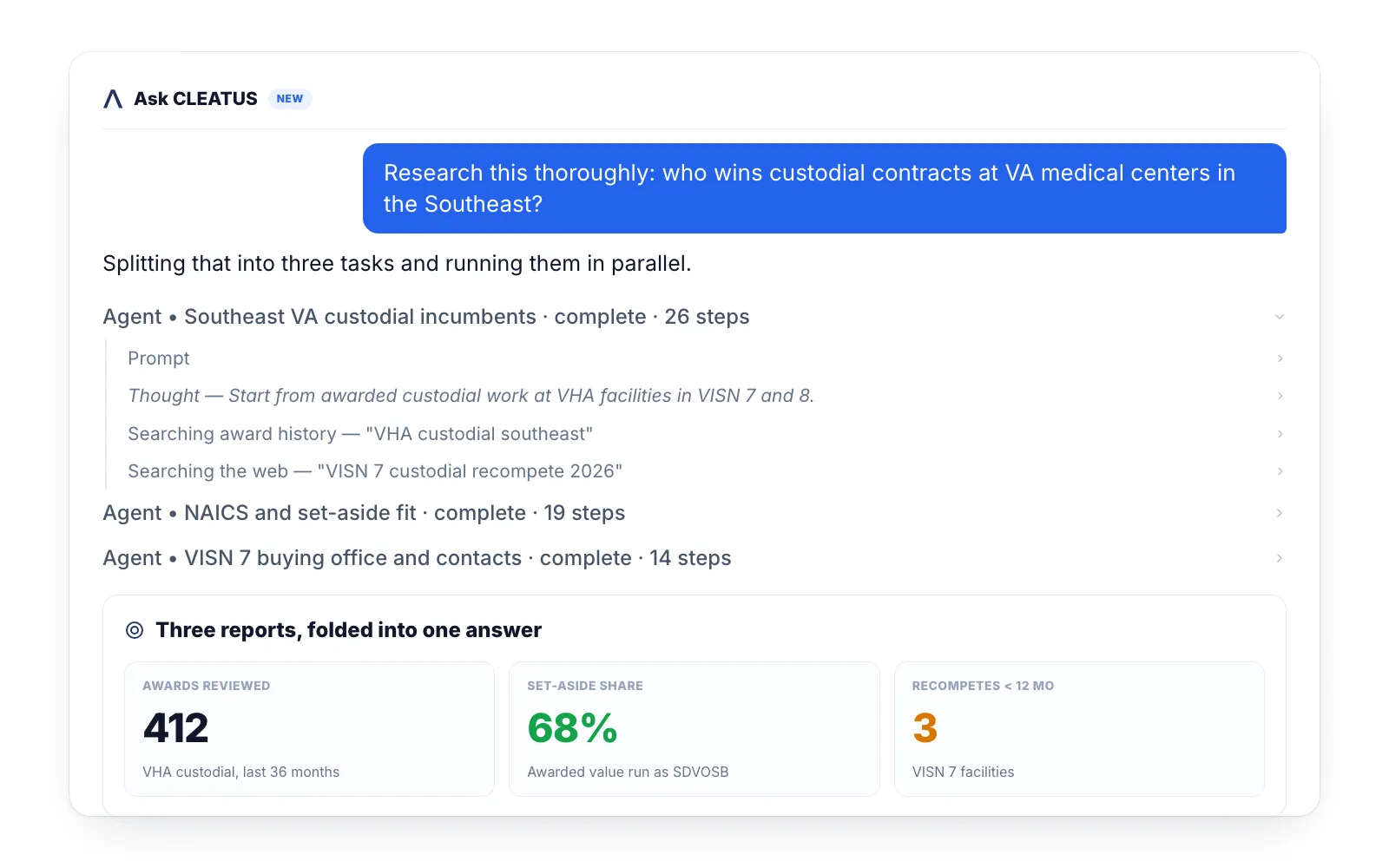
The CLEATUS agent handing one research question to subagents that run at the same time and report back one answer

Some questions are too big for one pass: shred a solicitation and its amendments, work up the incumbent and their award history, map the buying agency and the contracting officers behind it. Ask CLEATUS to research one of those properly and the agent stops answering and starts delegating. It writes a focused task, hands it to a subagent, and that subagent works in its own context with its own 21-tool research catalog: contract search, document outline, read and grep across every file in the solicitation package, semantic and award search, agency, contractor, and contracting-officer lookups, plus live web search and fetch. Up to three subagents run at the same time on independent tasks. Each one appears in the chat as a single live line. Open it and you see the exact task the agent wrote, every search the subagent runs, and its reasoning as it goes, and you can stop it whenever you want. Its tool traffic never enters your conversation, so a run that burns through a hundred searches costs your chat only the length of its report, and three separate investigations come back folded into one answer.

Learn more →

GovSpend

On GovSpend the agents are yours. Its MCP server page invites you to "Connect Claude, ChatGPT, CoPilot, or your custom AI agents directly to GovSpend," and its flagship agent customer story is about agents that customer built themselves. That is a genuine strength if you have engineers. It also means the research work, the orchestration, and the cost of running it all stay on your side of the line. GovSpend advertises no first-party research agent.[3]

AI proposal writing

CLEATUS

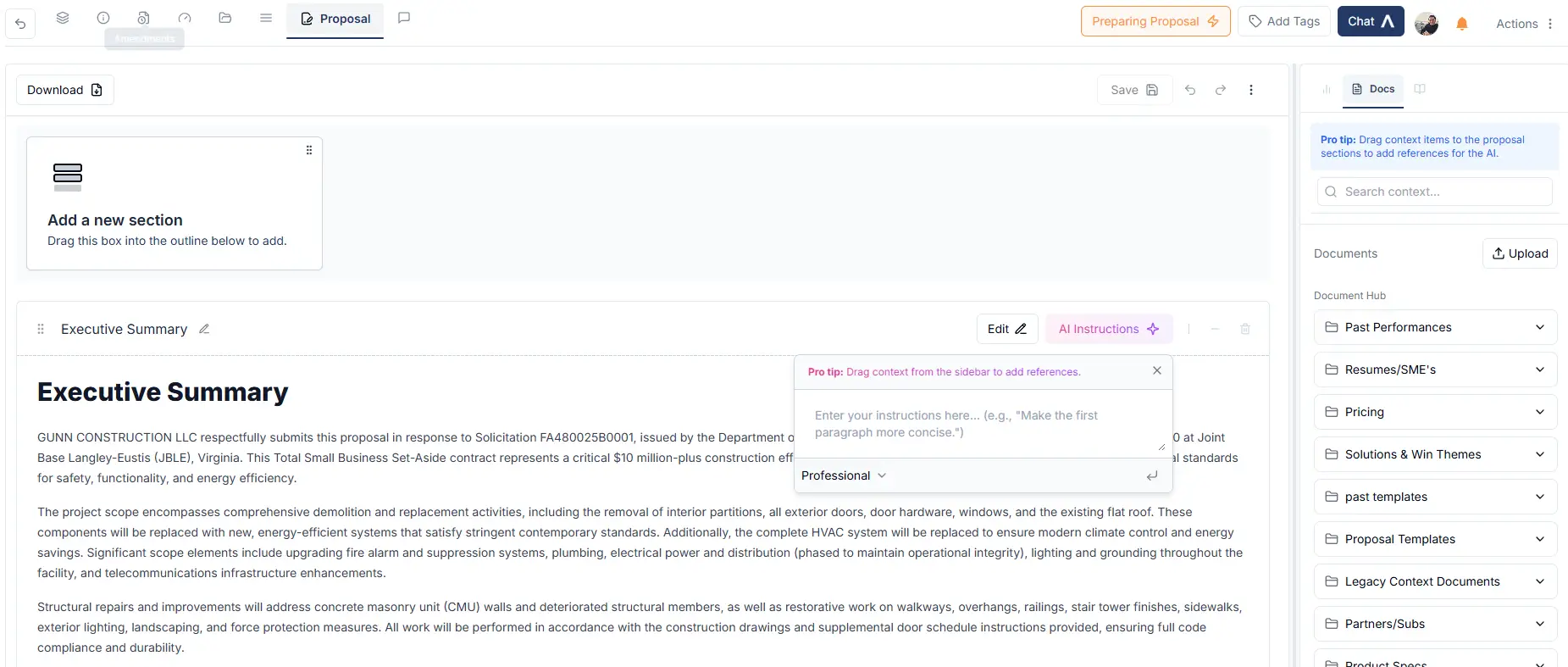
CLEATUS AI Proposal Writer drafting structured proposal volumes

CLEATUS AI Proposal Writer plans before it writes. Every proposal opens with a Proposal Plan built from your specific solicitation, running from "Review the solicitation" through "Format & assemble," with ready-to-send prompts written for each step and a Draft all button that runs the step as one batch. It extracts requirements and evaluation factors into a compliance matrix, drafts structured multi-volume proposals citing your real award history, checks steps off automatically as documents get drafted and compliance gets verified, reconciles the plan when an amendment posts, and exports professionally formatted Word and PDF files. Included on DATA + AI + Automations. The agent never fabricates past performance; it pulls from your UEI award history and Document Hub.

Learn more →

GovSpend

No AI proposal-writer product. GovSpend's AI drafts outbound-sales artifacts (cold emails, call scripts, and sales-brief PDFs) from an agency's purchase history, not multi-volume solicitation responses with compliance matrices.[4]

Visual workflow automation

CLEATUS

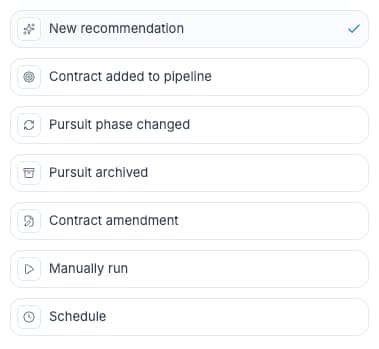
CLEATUS Workflows visual builder with triggers, AI agent steps, and Slack actions

CLEATUS Workflows is a force multiplier for capture and BD teams: a visual canvas with 13 trigger events, 19 addable step types, and 16 distinct actions that runs multi-step GovCon processes on autopilot. Each AI Agent step is its own agent with a model you pick, a scoped tool set, and a structured output schema, so it returns typed fields that later steps branch on instead of a blob of prose. Chain as many as you like, run them in parallel, query contracts, and search your documents, then route with If/Else and Filter. Triggers fire on new recommendations, new opportunities, pipeline changes, pursuits created, updated, or archived, phase moves, amendments, awards, matched custom alerts, schedules, webhooks, or on demand. Actions cover Slack, Microsoft Teams, email, webhooks, in-app notifications, log note, add to or remove from pipeline, change phase, assign member, create task, save document, Google Drive, and SharePoint. A dedicated Start Proposal step launches the full proposal writer inside the pursuit and can wait for the structured bid package to finish before downstream steps read it, run a review, and route the draft. Start from a prebuilt template (including a full Shipley capture pipeline) or describe the automation in plain English and let the platform assemble it. Unlimited on DATA + AI + Automations.

Learn more →

GovSpend

GovSpend offers alerts on saved searches, CRM sync to Salesforce and HubSpot, and a Slack app that can trigger CRM updates, but no standalone visual workflow-automation builder with AI agent steps and branching logic.[5]

Claude and ChatGPT integration

CLEATUS

CLEATUS surfacing GovCon opportunities inside ChatGPT via the MCP connector

CLEATUS is published as a one-click app in both official directories, the Claude.ai connector directory and the ChatGPT app store; under the hood, first-party MCP (Model Context Protocol) connectors expose the full agentic platform. Once connected, your AI assistant can search opportunities, read solicitations, draft proposal sections, generate documents, look up contracting officers, and update your pipeline using natural language. It takes action, not just reads. Included on DATA + AI.

Learn more →

GovSpend

GovSpend also ships an MCP server connecting Claude, ChatGPT, and CoPilot to its procurement data for pre-call briefings, expiring-contract scans, spend intelligence, and outreach drafting. The difference is scope: GovSpend's MCP reads its market-intelligence dataset, while CLEATUS's MCP acts on a capture pipeline and writes full proposals.[6]

Historical purchasing data and pre-RFP signal

CLEATUS

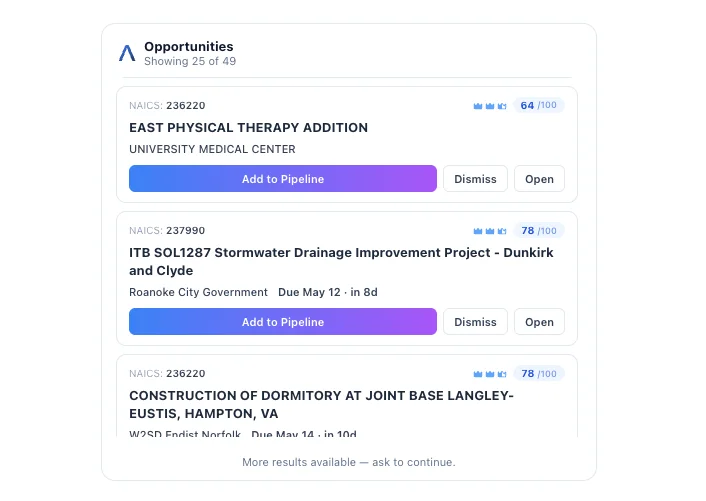
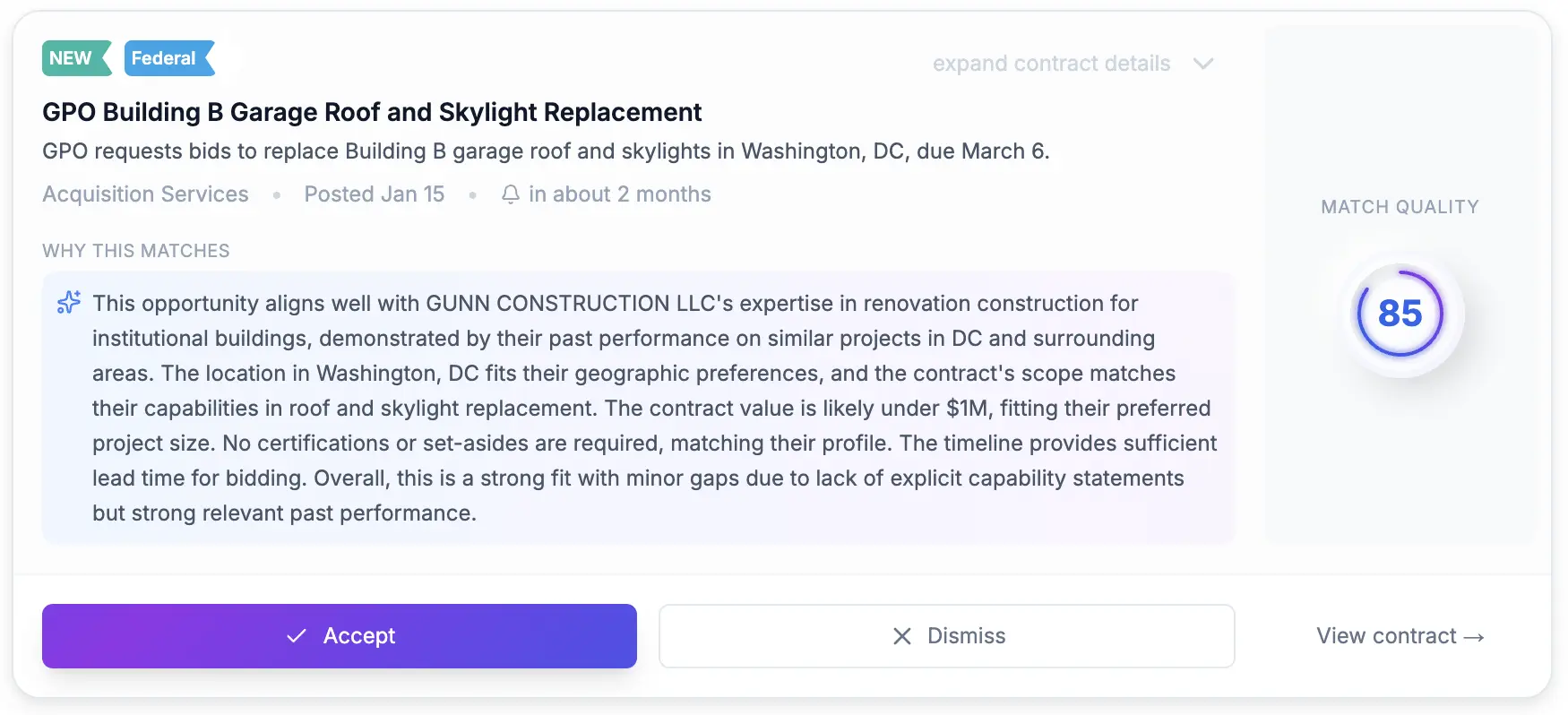
CLEATUS daily AI contract recommendations scored against a capture profile

CLEATUS leads with daily AI contract recommendations scored against your capture profile, forecasted opportunities, and AI pre-forecasting that flags expiring contracts for recompete likelihood 12 to 18 months out. For pricing and market context, the agent runs live web research (current wage determinations, market rates, and competitor award history) rather than maintaining a purchase-order warehouse.

Learn more →

GovSpend

This is GovSpend's core strength: 2B+ purchase-order line items, p-card and discretionary spend, agency contacts, and 2.8M+ public meeting transcripts, the historical purchasing record that powers share-of-wallet analysis and pre-RFP signal. If line-item spend data and meeting intelligence are central to your motion, GovSpend goes deeper here than CLEATUS.[7]

Pricing comparison

CLEATUS publishes self-serve pricing; GovSpend does not. CLEATUS DATA + AI, at a published $78/mo billed annually, opportunity discovery, market intelligence, and the action-taking Claude + ChatGPT MCP, while the sales-led DATA + AI + Automations tier adds the AI Proposal Writer and AI Workflows. Compare what you would pay against what each platform actually does for your team.

CLEATUS DATA + AI

$78/mo billed annually

Annual plan ($936/year). Opportunity discovery, GovCon AI chat, market intelligence, Claude + ChatGPT connectors, unlimited-pursuit CRM. No proposal writer, no workflows, no premium integrations.

See CLEATUS pricing →

CLEATUS DATA + AI + Automations

Contact us

Sales-led. Adds AI Proposal Writer, unlimited AI Workflows, native GSA eBuy + SeaPort NxG ingestion, API access, Zapier, unlimited pursuits, unlimited Document Hub.

See CLEATUS pricing →

GovSpend (custom quote)[12]

Not published

GovSpend does not publish pricing. Per its request-a-demo page, it has no tiered packages and sets a custom price per customer through a sales conversation.

Ready when you are

Switch your GovCon stack to CLEATUS

True agentic AI that plans, reasons, calls 33+ tools, searches the web, and executes multi-step GovCon tasks end-to-end

Daily AI contract matching against your capture profile, with high-fit opportunities and compliance analysis delivered to your inbox every morning

AI Proposal Writer, AI Workflows, and a Claude plus ChatGPT MCP that acts on your pipeline, execution GovSpend doesn't ship

Transparent self-serve pricing and an instant free trial, no sales call required

Miguel
Hillary
Keith Deutsch
Christine

Join 750+ contractors already using CLEATUS

What Our Clients are Saying

See what our customers saying about CLEATUS.

Dotted
CLEATUS vs GovSpend FAQ

Frequently Asked Questions

GovSpend is a B2G procurement-intelligence platform. Its strength is data: 2B+ purchase-order line items, agency spend, contacts, and 2.8M+ public meeting transcripts, surfaced for outbound public-sector sales and now exposed to AI tools through its own MCP server. CLEATUS is an AI-first GovCon execution platform. It writes multi-volume proposals with compliance matrices, runs visual AI Workflows, generates documents, and acts on your pipeline from inside Claude and ChatGPT. GovSpend tells you what agencies are buying; CLEATUS does the capture and proposal work that turns an opportunity into a submitted bid.

Independent comparisons of the wider GovCon software market, sourced the same way as this page and refreshed monthly.

  • 8 Best AI Capture Management Platforms for Federal Contractors

    CLEATUS, GovDash, Sweetspot, Deltek GovWin IQ, Procurement Sciences, TechnoMile, Civio RFX, and Unanet CRM, judged on how much of the capture process the software actually does versus how much it just tracks. GovSpend is not one of the eight platforms reviewed.

  • 8 Best GovCon CRM & Pipeline Management Software Platforms

    CLEATUS, Sweetspot, GovDash, TechnoMile, Unanet CRM, Deltek Costpoint, Procurement Sciences, and generic Salesforce or HubSpot builds, judged on how much of the pipeline maintains itself. GovSpend is not one of the eight platforms reviewed.

  • 10 Best Federal Bid Tracking & Opportunity Tracking Platforms

    CLEATUS, Deltek GovWin IQ, HigherGov, GovTribe, SamSearch, Sweetspot, GovDash Discover, GovSpend, BidNet Direct, and SAM.gov, judged on source coverage, match quality, pre-RFP visibility, amendment tracking, and what happens after the match. GovSpend is ranked eighth.

References

Numbered citations above link here. All sources are publicly available GovSpend marketing pages captured on 2026-08-31. Each source below carries its own capture date.

  1. [1]
    https://govspend.com/· captured 2026-08-31

    Sells "Procurement Data that Wins": public-sector intelligence that gives a seller the full picture before an RFP drops, namely "what agencies are buying, what they’re paying, who the incumbent is, and when the contract is up for renewal," across the SLED and federal markets.

  2. [2]
    https://govspend.com/govspend-platform/· captured 2026-08-31

    Ships AI Search + Notebook ("Think ChatGPT for B2G sales"), record-level AI Chat and pre-built Prompts inside Bid/Contract/Meeting records, and AI-generated summaries — natural-language search across GovSpend's data modules and the open web, powered by its custom MCP server. Use cases include generating a "Sales Brief PDF" for an opportunity.

  3. [3]
    https://govspend.com/mcp-server/· captured 2026-08-31

    Agents appear only as the customer’s own. The MCP server page invites you to "Connect Claude, ChatGPT, CoPilot, or your custom AI agents directly to GovSpend," and a customer testimonial describes agents that team built on the MCP server themselves. GovSpend supplies the data; you build the agents. No first-party research agent, no research runs that go in parallel, and no step-by-step view of an AI research run are advertised.

  4. [4]
    https://govspend.com/use-cases/· captured 2026-08-31

    No AI proposal-writer product is advertised. The closest capability is MCP-driven "Proposal & Outreach Automation" that drafts a cold email and call script, and an AI-generated "Sales Brief PDF" — outbound-sales artifacts, not multi-volume solicitation responses with compliance matrices.

  5. [5]
    https://govspend.com/tech-stack-integrations/· captured 2026-08-31

    Listed integrations are an MCP Server, a Native Slack App (marked "Coming in June"), CRM Integration (Salesforce and HubSpot), API Access, and SSO (SAML). The Slack app can "trigger workflows that connect Slack to your CRM," but no standalone visual workflow-automation builder is advertised.

  6. [6]
    https://govspend.com/mcp-server/· captured 2026-08-31

    Ships an MCP Server that connects "Claude, ChatGPT, CoPilot, or your custom AI agents directly to GovSpend" — putting "15 years of government procurement data" inside the AI tools a team already uses. The AI can run pre-call briefings, expiring-contract scans, spend intelligence, competitor battle cards, and "Proposal & Outreach Automation" that drafts a cold email and call script from an agency's purchase history.

  7. [7]
    https://govspend.com/vendors-contractors/· captured 2026-08-31

    Centers on historical purchasing data "down to the line item" — purchase orders, p-card and discretionary spend, pricing, quantities, and suppliers — to size addressable market and run competitor share-of-wallet analysis. Pitches surfacing "the critical 80%" of spend that never goes out for bid (p-cards, discretionary spend, co-ops/contracts).

  8. [8]
    https://govspend.com/our-company/· captured 2026-08-31

    Meeting Intelligence is an AI-powered module that collects and transcribes millions of public meeting videos, transcripts, and documents, 2.8M+ meetings as captured, so sellers can catch pre-RFP planning and budgeting signals. Transcripts are searchable by keyword, agency, or date.

  9. [9]
    https://govspend.com/fedmine-platform/data/· captured 2026-08-31

    The Fedmine federal platform aggregates and standardizes 19 federal data sources — including FPDS contract awards, SAM.gov opportunities and entity registrations, USASpending subcontracts, GAO bid protests, GSA Schedules, SBA small-business data, Grants.gov, and the CALC+ labor-rate tool — with contract search data dating back to 2004.

  10. [10]
    https://govspend.com/govspend-platform/· captured 2026-08-31

    The Opportunities module continuously evaluates bids, contracts, meetings, spending activity, and public-web sources to surface and rank buying signals by relevance to a seller's products, services, agencies, regions, and competitors. Expiring incumbent contracts are positioned as "the highest-intent buying trigger in government."

  11. [11]
    https://govspend.com/tech-stack-integrations/· captured 2026-08-31

    CRM Integration pushes records across all five GovSpend modules (Meetings, Bids, Contacts, Contracts, Purchase Orders) into Salesforce, HubSpot, or custom CRM objects with field mapping and scheduled syncs. The product positions a connected CRM as the pipeline system of record rather than a native pursuit/proposal workspace.

  12. [12]
    https://govspend.com/request-a-demo/· captured 2026-08-31

    Does not publish pricing. The request-a-demo page states: "we don't have tiered pricing based on packages or access. Instead, we rely on exploratory conversations" and builds a custom price per customer. Every entry path routes to "Request a Demo" with a sales team.

Source disclosure

Information about GovSpend is accurate as of 2026-08-31, sourced from publicly available marketing materials. Spot something wrong? Email legal@cleat.ai and we'll review and correct it.

GovSpend and the GovSpend logo are trademarks of their respective owner and are used here for nominative comparison only. CLEATUS is not affiliated with, endorsed by, or sponsored by GovSpend.