| Core positioning | Self-serve AI-first GovCon platform — daily AI contract matching, automatic contract breakdown, AI Proposal Writer, AI Workflows, and Claude + ChatGPT MCP in one product, with published pricing and a free trial | Sales-led AI-first GovCon platform branded "Awarded AI" covering proposals, capture, and business development, sold via demo and annual contract[3] |
|---|
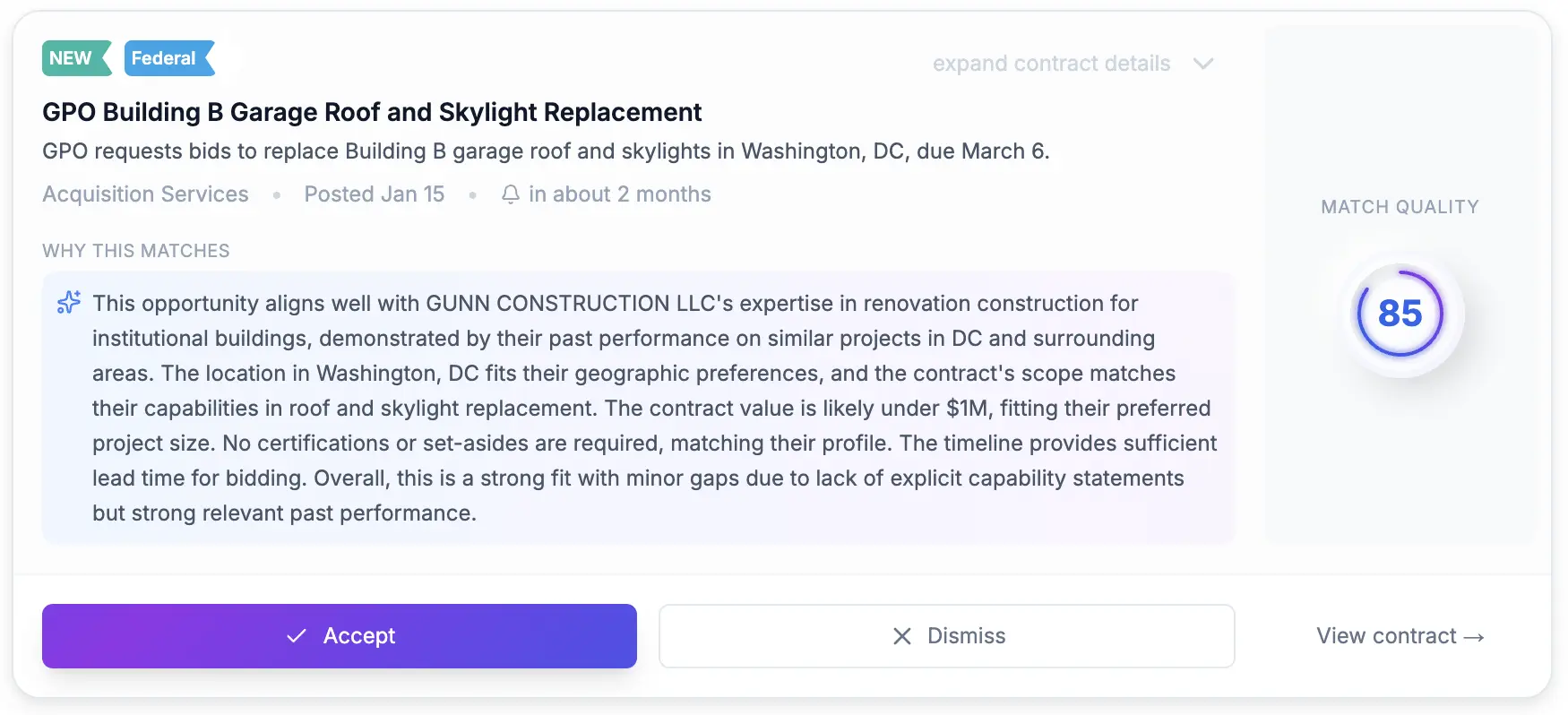
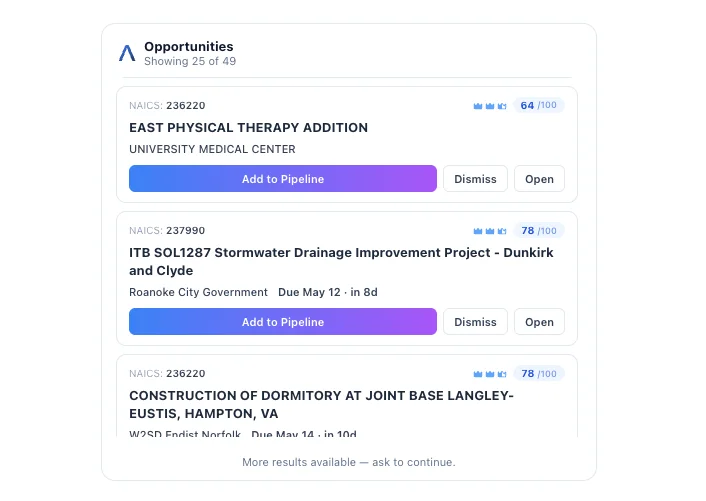
| Daily AI contract matching | Every day, CLEATUS scores every new federal, SLED, DLA DIBBS, GSA eBuy, SeaPort NxG, PIEE, grant, and subcontract opportunity against your capture profile and delivers high-fit matches with a compliance analysis to your inbox — automating capture management end-to-end | Bid Search and Smart Matching modules surface relevant opportunities and predict matches from your past bids[4] |
|---|
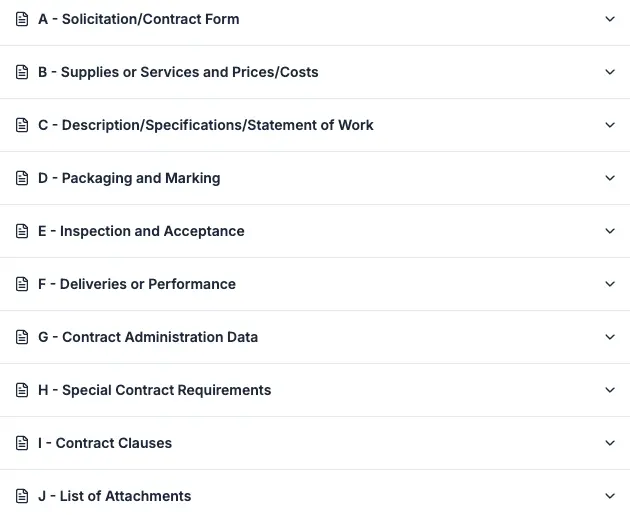
| AI contract breakdown (pre-shredding) | Every matched opportunity arrives pre-shredded, before anyone opens it: CLEATUS reads every page of the package (base solicitation, amendments, attachments, exhibits) and breaks it into one standardized Contract Breakdown following the Uniform Contract Format: scope, requirements, deliverables, deadlines, pricing, and evaluation criteria. That breakdown is what your PWIN score is computed against, so the score reads Sections C, H, K, L, and M plus the attachments instead of a title, a NAICS code, and a set-aside. When a package has not been read, the card says so and the confidence drops rather than the model filling the gap. One format across federal, state, and local also means search works at the requirement and scope-of-work level, and agent answers stay grounded in structured data | AI Review evaluates proposal drafts against compliance criteria *after* you write them; pre-shredding every inbound solicitation into a standardized format is not described in public marketing[4] |
|---|
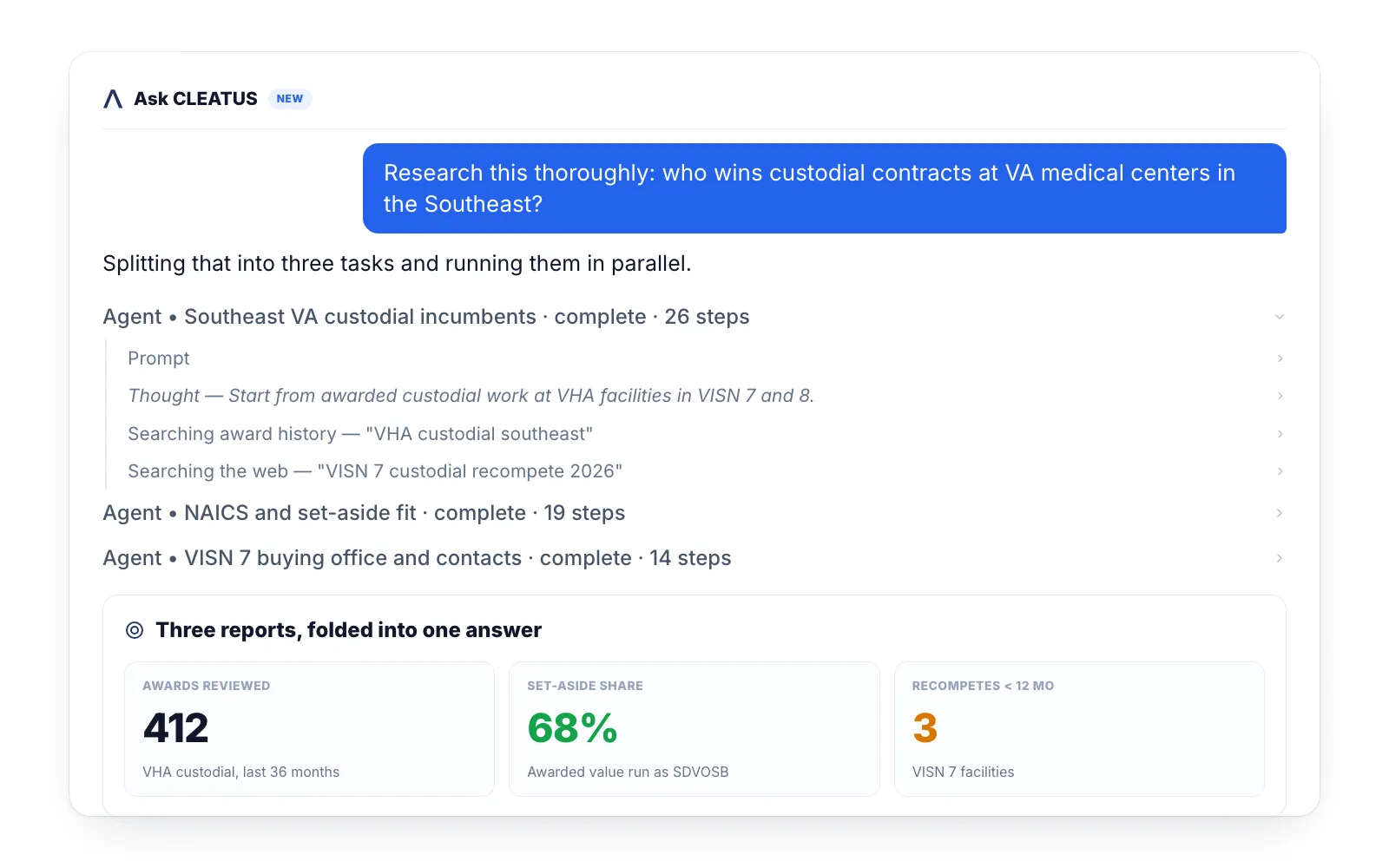
| Parallel research subagents | Ask for real research and the agent hands the job to subagents: separate AI researchers, each with its own context and its own 21-tool research catalog covering contracts, solicitation documents, award history, agencies, contracting officers, and the web. Up to three run at the same time on independent tasks. Each one is a live line in the chat you can open to read the exact task it was given and every search it makes, and you can stop it mid-run. Their tool traffic never enters your conversation, so three investigations come back folded into one answer instead of a wall of raw results. Included from DATA + AI | Deep Research is an agentic template library: thirteen purpose-built templates you pick from and launch, described as multi-step agentic research. Nothing describes several research agents running at the same time, a live view of every search each one makes, stopping a run in progress, or research on a question you write yourself instead of a template[5] |
|---|
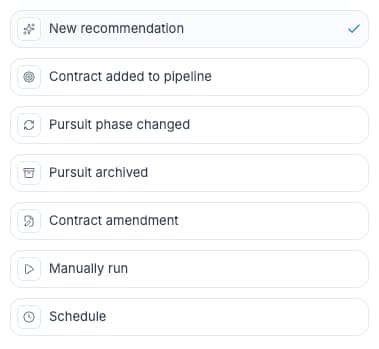
| Agent orchestration | The agent is a step; the workflow is the conductor. This is Zapier or n8n rebuilt for GovCon: a canvas with 13 trigger events, 19 addable step types, and 16 distinct actions. Every AI Agent step picks its own model and reasoning effort, gets its own scoped list of tools it may call, and returns a structured output schema, so the If/Else and Filter steps after it branch on typed fields instead of on prose. Steps run in parallel, one agent step can fan out across a whole set of items at once, and a dedicated Start Proposal step launches the full proposal writer and waits for the finished bid package before later steps read it. Nine ship as named agents you can run today (Go/No-Go, Qualification, Amendment Watch, Award Monitor, Recompete, and more), or describe the automation in plain English and it assembles itself. Unlimited on DATA + AI + Automations | No automation engine of its own is advertised. The platform page offers automated compliance reviews and drafting that "Seamlessly Adapts to Your Workflows", which is fitting the process you already run rather than executing it. No trigger events, no step types, no branching, and no builder surface appear on any captured page[6] |
|---|
| Native file authoring | The agent writes the real file, it does not export one at the end. Submission volumes are authored as actual .docx through the same render path as the Export as Word button. Decks are real .pptx built with python-pptx, pricing and line-item workbooks are real .xlsx or .csv, and a Government-supplied workbook is filled in place with a value-only patcher so the template structure survives. A supplied Word document is filled in place too, keeping its layout, headers, and handling markings rather than being rebuilt. Flat and fillable government PDF forms get every field filled. PDF is the one format the agent does not author: any document, or the whole bid package, exports to PDF or Word on demand | Ships an Add-in for Microsoft Word that brings Awarded AI "directly inside the document you are already working in," so drafting happens in Word rather than the file being authored for you. No native deck or workbook authoring, and no in-place fill of a Government-supplied pricing workbook or flat PDF form, appears on the captured pages[7] |
|---|
| AI proposal writing | AI Proposal Writer opens every bid with a Proposal Plan built from your solicitation, checks steps off as the work lands, reconciles the plan when an amendment posts, and drafts multi-volume proposals with compliance matrices and win-strategy plans, grounded in your UEI award history and Document Hub — exported as Word and PDF on the DATA + AI + Automations plan | Awarded AI Draft + AI Review modules generate proposal drafts, outlines, and compliance matrices, marketed as "90% faster"[8] |
|---|
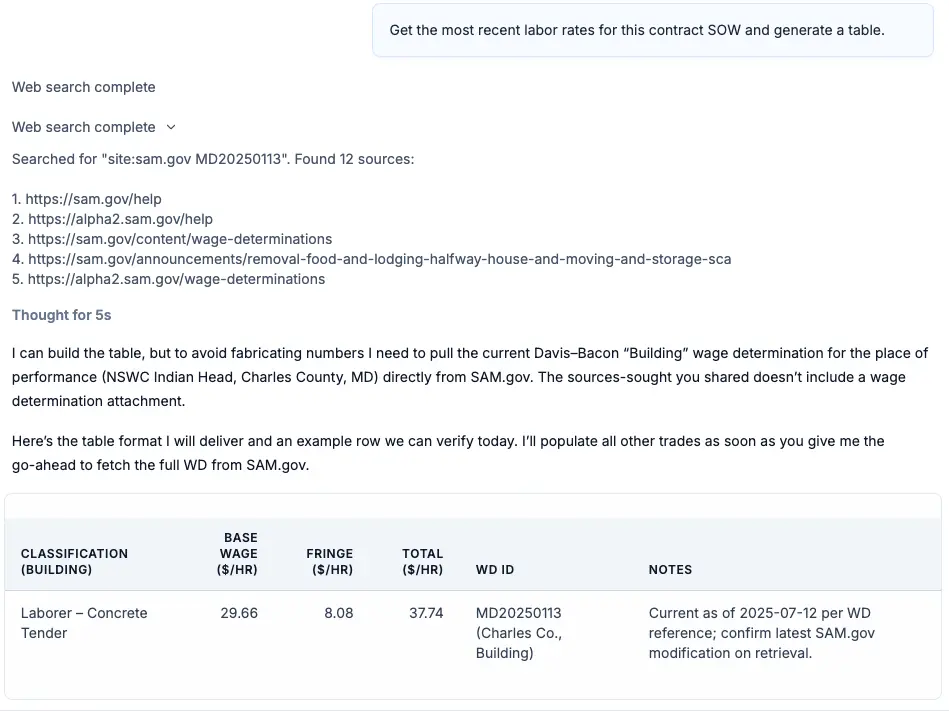
| Agentic AI — tool calls, reasoning, web research | True agentic AI: the agent plans a multi-step solution, then calls real tools — 33 MCP tools plus semantic search across contracts/awards/contractors/agencies/people/NAICS, document outline + read, grep across your Document Hub, autonomous web search, file/spreadsheet generation, and pipeline mutations. Reasons, researches, executes, and cites sources — no human in between steps. | Marketed as generative AI for drafting and reviewing proposals (AI Chat, AI Draft, AI Review). Public marketing does not describe tool calls, agentic reasoning, autonomous research, or multi-step task execution — it is presented as text-in, text-out generation, not an agent that takes actions.[4] |
|---|
| End-to-end GovCon operations automation | Automates your GovCon operations end-to-end — multi-step AI automations run capture screening, go/no-go prep, amendment monitoring, award-lead delivery, and team routing on autopilot. Force multiplier for capture and BD teams. AI Agent steps with their own model, scoped tools, and structured output, plus If/Else and Filter branching on that typed data, Slack/email/webhook/pipeline actions. Unlimited on DATA + AI + Automations. | No automation engine of its own is advertised. The platform page offers automated compliance reviews and drafting that "Seamlessly Adapts to Your Workflows", which is fitting the process you already run rather than executing it. No trigger events, no step types, no branching, and no builder surface appear on any captured page[6] |
|---|
| Claude and ChatGPT integration | One-click apps published in both official directories, the Claude.ai connector directory and the ChatGPT app store, connectable at /agents/claude and /agents/chatgpt, turn CLEATUS into a tool inside Claude.ai and ChatGPT — included from DATA + AI | No Claude or ChatGPT MCP connectors in public marketing |
|---|
| Integrations | Zapier (5,000+ apps including Microsoft 365 and Slack), native Slack workflow actions, native GSA eBuy ingestion (OASIS+ and MAS RFQs), SeaPort NxG task orders, and a public API at /integrations | No Zapier, Slack, GSA eBuy, or SeaPort NxG integrations documented in public marketing[4] |
|---|
| Opportunity coverage | SAM.gov, 50,000+ SLED sources, DLA DIBBS, GSA eBuy (OASIS+ and MAS RFQs), SeaPort NxG, PIEE directed solicitations, Grants.gov (including SBIR/STTR), subcontract leads, federal forecasts, and AI pre-forecasting that scores expiring contracts for recompete likelihood 12–18 months ahead | Marketed as "federal, state, and local" coverage via Bid Search; specific source list and SLED scale not quantified in public marketing[9] |
|---|
| Pricing transparency and self-serve start | Published self-serve pricing — $78/mo (DATA + AI) on annual plans, plus a 7-day free trial; DATA + AI + Automations is sales-led | Pricing not published publicly; not transparent — primary CTA is "Book a Demo"[10] |
|---|
| FedRAMP and CMMC compliance | FedRAMP Moderate Equivalency expected Q3 2026, audit pending | SOC 2 Type 2, CMMC Level 2 Assessed, and FedRAMP® Moderate Authorization on the Awarded AI platform; Azure Government deployment designed to meet NIST 800-171 for CUI[11] |
|---|
| Deployment options | Cloud-hosted multi-tenant SaaS | Three deployment models on a single-tenant architecture — Azure Commercial, Azure Government Cloud (GCC High compatible), and customer-managed Kubernetes for air-gapped or strict-residency workloads[12] |
|---|
| Formal AI certification program | In-product onboarding, help center, and account-executive support on annual plans — no standalone exam-based certification | Awarded AI Certification Program: a "Crawl, Walk, Run" series or the Awarded AI Academy onboarding courses, four or more company-hosted webinars, and a comprehensive final exam for proposal, BD, and capture professionals[13] |
|---|
| Entry-level annual price | $78/mo billed annually ($936/year) on the DATA + AI plan — opportunity discovery, GovCon AI chat, market intelligence | Not published publicly; pricing is not transparent[10] |
|---|
| Full AI stack | DATA + AI + Automations (sales-led, contact us) — AI Proposal Writer, AI Workflows, GSA eBuy, SeaPort NxG, API access, unlimited pursuits | Pricing gated behind a sales conversation, with annual contracts standard[10] |
|---|