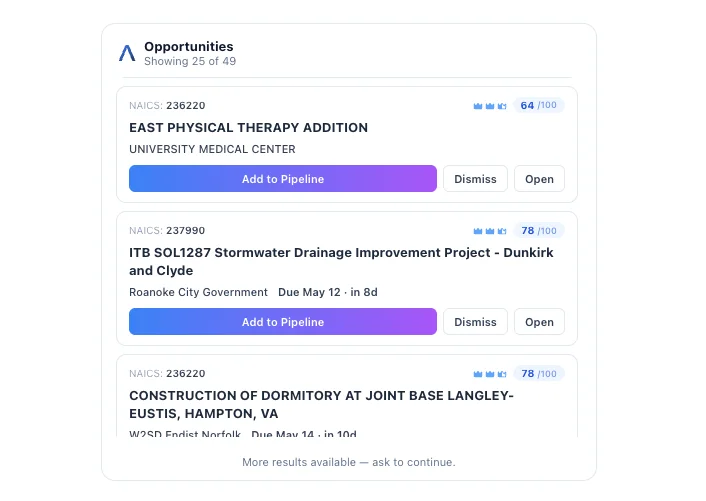
| Core positioning | Agentic AI platform for the full GovCon lifecycle: discovery, capture, proposal writing, and composable workflow automation, with the agent able to plan, reason, call 33+ tools, and execute multi-step work end to end | AI for GovCon across six modules: Opportunity Discovery, Federal Market Intelligence, Agentic Monitors, Pipeline Management, Proposal Engine, and Organization Library[1] |
|---|
| AI contract breakdown (pre-shredding) | Every matched opportunity arrives pre-shredded, before anyone opens it: CLEATUS reads every page of the package (base solicitation, amendments, attachments, exhibits) and breaks it into one standardized Contract Breakdown following the Uniform Contract Format: scope, requirements, deliverables, deadlines, pricing, and evaluation criteria. That breakdown is what your PWIN score is computed against, so the score reads Sections C, H, K, L, and M plus the attachments instead of a title, a NAICS code, and a set-aside. When a package has not been read, the card says so and the confidence drops rather than the model filling the gap. One format across federal, state, and local also means search works at the requirement and scope-of-work level, and agent answers stay grounded in structured data | The Proposal Engine shreds the RFP with Section C/L/M parsing once you start a proposal, generating compliance and capability matrices and an annotated outline. Shredding is part of the proposal flow you initiate; an automatic standardized breakdown of every matched opportunity before you engage it is not advertised[2] |
|---|
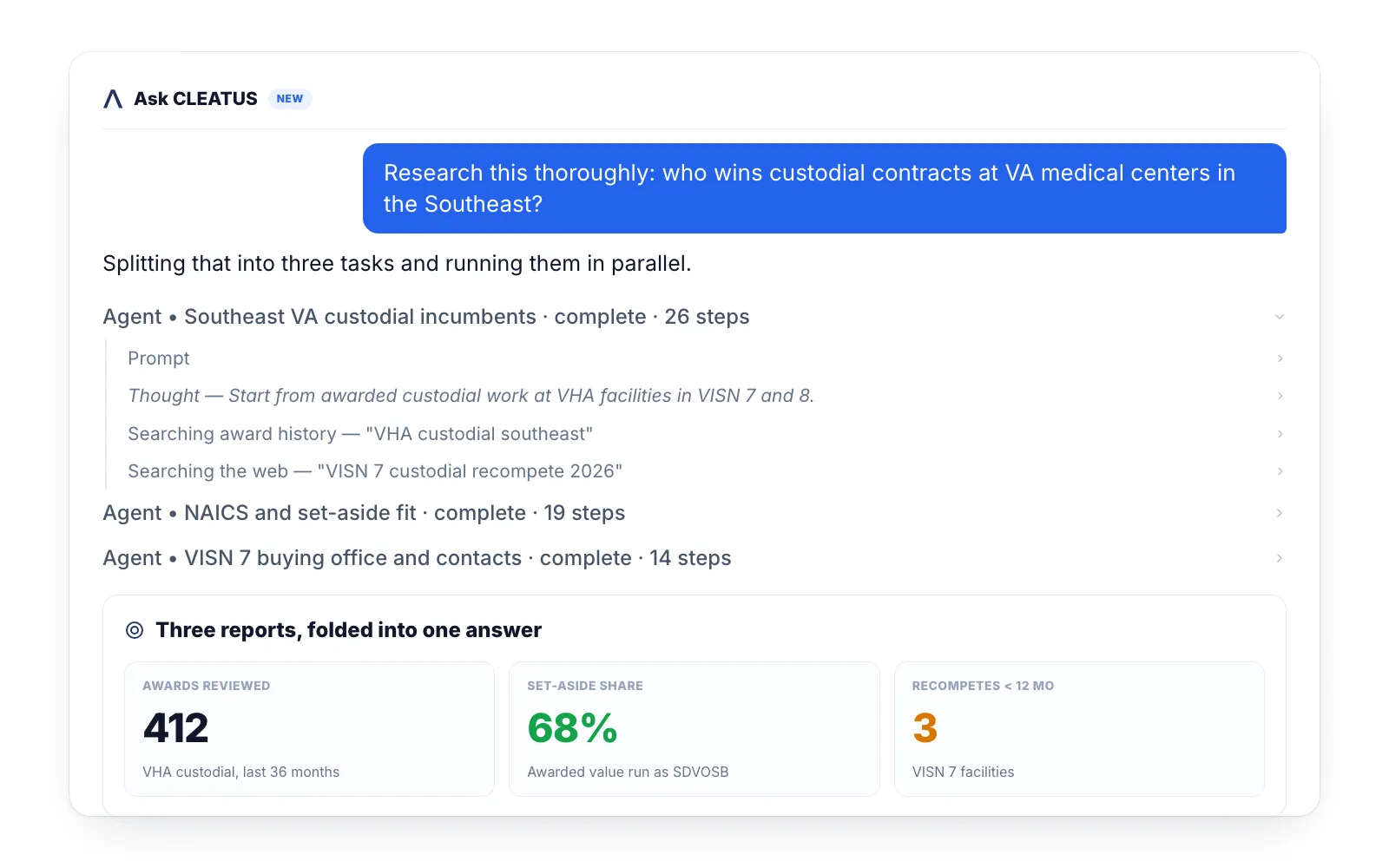
| Parallel research subagents | Ask for real research and the agent hands the job to subagents: separate AI researchers, each with its own context and its own 21-tool research catalog covering contracts, solicitation documents, award history, agencies, contracting officers, and the web. Up to three run at the same time on independent tasks. Each one is a live line in the chat you can open to read the exact task it was given and every search it makes, and you can stop it mid-run. Their tool traffic never enters your conversation, so three investigations come back folded into one answer instead of a wall of raw results. Included from DATA + AI | An Agentic Monitor runs a research agent that checks the web daily against instructions you write, then alerts you. That is a scheduled watch, not research you delegate. Nothing describes several agents working one question at the same time, a live view of every search, or stopping a run in progress[3] |
|---|
| Agent orchestration | The agent is a step; the workflow is the conductor. This is Zapier or n8n rebuilt for GovCon: a canvas with 13 trigger events, 19 addable step types, and 16 distinct actions. Every AI Agent step picks its own model and reasoning effort, gets its own scoped list of tools it may call, and returns a structured output schema, so the If/Else and Filter steps after it branch on typed fields instead of on prose. Steps run in parallel, one agent step can fan out across a whole set of items at once, and a dedicated Start Proposal step launches the full proposal writer and waits for the finished bid package before later steps read it. Nine ship as named agents you can run today (Go/No-Go, Qualification, Amendment Watch, Award Monitor, Recompete, and more), or describe the automation in plain English and it assembles itself. Unlimited on DATA + AI + Automations | Agentic Monitors are trigger-and-alert: describe what to watch, a research agent checks daily, and "You decide what triggers an alert." The output is a notification. There is no canvas with agent steps, nothing that branches on what a step returned, no steps running side by side, and no step that starts a proposal build and waits for it[4] |
|---|
| Native file authoring | The agent writes the real file, it does not export one at the end. Submission volumes are authored as actual .docx through the same render path as the Export as Word button. Decks are real .pptx built with python-pptx, pricing and line-item workbooks are real .xlsx or .csv, and a Government-supplied workbook is filled in place with a value-only patcher so the template structure survives. A supplied Word document is filled in place too, keeping its layout, headers, and handling markings rather than being rebuilt. Flat and fillable government PDF forms get every field filled. PDF is the one format the agent does not author: any document, or the whole bid package, exports to PDF or Word on demand | Exports proposals to Microsoft Word with your branding, styles, headers, footers, and a generated table of contents, and the compliance matrix to Word or Excel. Through the Microsoft 365 connection its AI creates and edits Word documents with styles and generates PowerPoint decks from opportunity context. The authoring runs against Office through that connection; no in-place fill of a Government-supplied workbook or flat PDF form is advertised[5] |
|---|
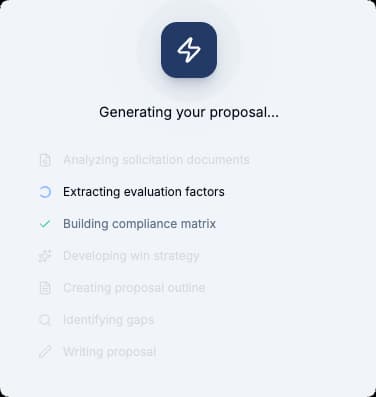
| Proposal planning before drafting | Every proposal opens with a Proposal Plan built from your solicitation, running from "Review the solicitation" through "Format & assemble." Steps check themselves off as documents get drafted and compliance gets verified, the plan updates itself when an amendment posts, and the agent asks you a targeted question instead of guessing when a decision is unresolved | Shreds the RFP with Section C/L/M parsing, then auto-generates a compliance matrix, a capability matrix, and an annotated outline before drafting. No self-checking plan that reconciles itself against amendments, and no targeted follow-up questions when the solicitation leaves a decision open[2] |
|---|
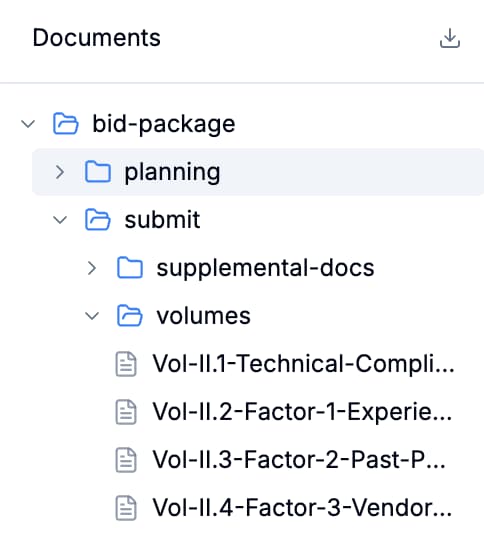
| Bid package output and government forms | Creates the real folder and file structure: separate volumes and sections mapped to evaluation factors, with Section L page limits and formatting enforced. Generates spreadsheets for pricing volumes and fills every field on flat, non-typeable government PDFs (reps and certs, IRS forms, response templates). Exports Word and PDF | Produces Pink Team drafts and exports to Microsoft Word with your branding, styles, headers, footers, and generated table of contents; the compliance matrix exports to Word or Excel. No flat-PDF form fill for non-typeable government forms is advertised[6] |
|---|
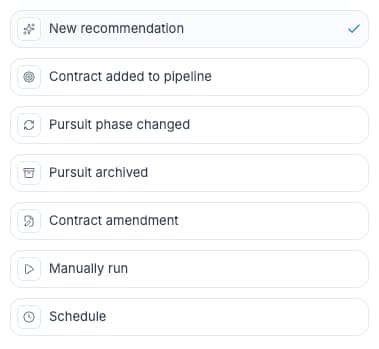
| AI Workflows automation | A real visual automation engine, not an alert rule. 13 trigger events (new opportunity, recommendation, pursuit created/updated/archived, phase change, pipeline add, amendment posted, award posted, custom alert matched, schedule, webhook, manual), 19 addable step types, and 16 distinct actions. Every AI Agent step is its own agent with a chosen model, scoped tools, and a structured output schema, so later steps branch on real typed data. If/Else and Filter branching, parallel steps, contract queries, and document search. A dedicated Start Proposal step launches the full proposal writer and waits for the bid package to finish before downstream steps read it. Start from a prebuilt template (including a full Shipley capture pipeline) or describe the workflow in plain English and it assembles itself. Unlimited on DATA + AI + Automations | Pipeline "Custom Fields & Workflows" covers custom fields, required fields per stage, custom dropdowns, and export, alongside two-way Salesforce sync. No visual automation builder with triggers, AI agent steps, or branching logic is advertised[7] |
|---|
| Claude and ChatGPT integration | One-click apps published in both official directories, the Claude.ai connector directory and the ChatGPT app store. Your assistant searches opportunities, reads solicitations, drafts proposal sections, generates documents, and updates your pipeline. It takes action, not just answers. Included from DATA + AI | A ChatGPT app in the ChatGPT app store. No Claude connector and no MCP server for connecting your own AI tools[8] |
|---|
| Agentic AI document generation | The agent generates executive summaries, capability statements, past-performance narratives, pricing tables, compliance matrices, and charts, exports them as Word, PDF, Excel, or PowerPoint, and can organize your Document Hub for you | Generates compliance and capability matrices, outlines, Pink Team drafts, RFI and Sources Sought responses, capability statements, and proposal graphics (org charts, process flows, solution architectures)[2] |
|---|
| Opportunity coverage | Federal (SAM.gov), 50,000+ SLED sources across the US and Canada, DLA DIBBS, GSA eBuy (OASIS+ and MAS RFQs), SeaPort NxG, PIEE directed solicitations, Grants.gov, subcontracts | 1M+ opportunities from 1,000+ data sources: SAM.gov, USAspending, FPDS, DIBBS, Grants.gov, SBIR/STTR, and 1,000+ state and local procurement portals across all 50 states[9] |
|---|
| GSA eBuy and vendor-portal channels | Native GSA eBuy integration (OASIS+ and MAS RFQs) and SeaPort NxG task orders on DATA + AI + Automations, ingested directly rather than by email forwarding | GSA eBuy works by forwarding your eBuy RFQ notification emails to a per-organization ingest address, noted as available on request. A Deltek GovWin integration imports GovWin opportunities as pursuits. No SeaPort NxG channel[10] |
|---|
| Forecasts and pre-RFP signal | Forecasted opportunities plus AI pre-forecasting that scores expiring contracts for recompete likelihood 12 to 18 months out, with subcontract and recompete signals delivered as daily recommendations | Searchable agency procurement forecasts filterable by agency, NAICS, set-aside, value, and timing, linked to incumbents and award history, plus recompetes surfaced from contract end dates and budget and appropriations trends[11] |
|---|
| Capture and pursuit management | Kanban, list, calendar, and table views with live solicitation amendments, AI workflows attached to pipeline events, team collaboration, and unlimited pursuits on DATA + AI + Automations | Native GovCon CRM with Dashboard, List, Board, and Calendar views, customizable drag-and-drop stages, pipeline KPIs, activity history, two-way Salesforce sync, and cross-organization teaming workspaces with external guest access[7] |
|---|
| Federal market intelligence | Agency hierarchies, top contracting offices, contracting-officer contacts, competitor and subcontractor award history, award-history timelines, vehicle award families, expressed-interest data, and government locations | 167M+ federal awards from USAspending and FPDS with plain-language AI search, obligation timelines, sub-award detail, contractor profiles with cash flow and corporate hierarchy, protests, contract vehicles, and budget and appropriations trends[11] |
|---|
| Monitoring and alerts | Daily AI contract recommendations scored against your capture profile, contract digest emails, AI-built custom alerts, and amendment alerts that can trigger a workflow rather than only a notification | Agentic Monitors watch vendors and competitors, live opportunities, agencies and offices, and the open web with a daily research agent, filtered per signal into a universal inbox and delivered by email, Slack, and in-app, with Teams support listed as coming soon[12] |
|---|
| Microsoft 365 and Office integration | SharePoint, Google Drive, and Microsoft Teams integrations, plus Word, PDF, Excel, and PowerPoint export. No Word plug-in and no GCC High environment | Deeper Office coverage: Sweetspot AI creates and edits Word documents with styles, generates PowerPoint decks, drafts and sends Outlook email, and browses OneDrive and SharePoint, across Commercial, GCC, and GCC High[5] |
|---|
| Published security certifications | FedRAMP Moderate Equivalency expected Q3 2026, audit pending. A sales-led GovCloud tier for compliance-sensitive teams adds FedRAMP GovCloud hosting, CMMC Level 2 alignment, SSO, and audit logs, alongside AES-256 encryption, role-based access control, and no AI training on customer data | Publishes CMMC 2.0 Level 2 certification aligned to NIST SP 800-171, SOC 2 Type II certification, and FedRAMP Moderate Authorization marked in progress, with zero-day AI data retention, FedRAMP High AI infrastructure, private tenant architecture, and a 100% US-citizen team[13] |
|---|
| API access and custom integrations | Public REST API with OAuth, plus Zapier, on DATA + AI + Automations. See /integrations | No public API advertised on the homepage, features index, feature pages, pricing page, or comparison page. Named integrations are Microsoft 365, SharePoint, Salesforce, Slack, the GSA eBuy email ingest, and Deltek GovWin[14] |
|---|
| Pricing transparency | Published self-serve pricing: $39/mo DATA and $78/mo DATA + AI, billed annually. DATA + AI + Automations and GovCloud are sales-led. See /pricing | No published pricing. The pricing URL renders "See Sweetspot in Action" with a demo scheduler and no plans, tiers, or prices[15] |
|---|
| Getting started | Instant self-serve free trial, no sales call required | Request Demo only; every entry path routes to the sales team, with no free trial or self-serve signup[15] |
|---|